
China’s heat-pump supply chain is attracting attention as buyers look for efficient hot-water systems and dependable manufacturing partners. A Heat Pump Water Tank may seem like a simple vessel, but its insulation, corrosion protection, heat-exchanger design, and controls can affect system performance and service life. Small details matter. A poorly matched tank can undermine an otherwise capable heat pump.
The International Energy Agency’s 2022 report, The Future of Heat Pumps, estimates that heat pumps could cut global carbon dioxide emissions by at least 500 million tonnes in 2030 under its stated scenario. The report also projects that heat-pump installations in buildings could rise from 180 million in 2020 to around 600 million by 2030 in its net-zero pathway. These are global projections, not guarantees of demand for any single product or market. That distinction matters.
IEA Executive Director Fatih Birol described heat pumps as “a key technology for the global transition to secure and sustainable heating.” For buyers comparing China Best Heat Pump Water Tank Manufacturers, that broader shift is useful context, but it is not a substitute for product evidence. Look closely at tank materials, insulation specifications, pressure and temperature ratings, testing procedures, production consistency, and after-sales support. Ask for documentation, and check that claims match the model being offered. A polished brochure is not enough. Supplier rankings can simplify research, yet they may overlook differences in application, installation conditions, and quality control. This guide sets out practical criteria for comparing manufacturers, while recognizing that no single factory is the right fit for every project.
A heat pump water tank stores hot water in an insulated cylinder and uses heat from surrounding air to warm it. A fan draws air across an evaporator, where refrigerant absorbs heat. The compressor raises the refrigerant’s temperature, and a heat exchanger transfers that heat to the stored water. It works like a refrigerator in reverse. Many units also include an electric resistance element for high demand or colder conditions. Small details matter: airflow, room temperature, and a clear condensate drain can affect everyday performance.
The U.S. Department of Energy’s Energy Saver guidance says heat pump water heaters can be two to three times more energy efficient than conventional electric resistance models. That figure describes potential efficiency, not a guaranteed household bill reduction. Actual results depend on use patterns, installation, and the space around the unit. In a cramped, chilly utility room, recovery may feel slower than expected. This is worth checking before choosing a tank size. Insulation also helps limit standby heat loss, while regular filter cleaning supports airflow. One limitation is easy to overlook: the unit removes heat from its surroundings, so a small room may become cooler during operation.
A heat pump water heater extracts heat from surrounding air and transfers it to the tank. In this simplified example, delivering 3 kWh of heat takes 1 kWh of electricity and 2 kWh of heat from the air (COP 3.0). An electric-resistance heater uses about 3 kWh of electricity for the same heat output. Actual performance varies with the unit and operating conditions.
China’s heat pump water tank manufacturing landscape combines metalworking, insulation, component sourcing, and system testing. Factories may produce stainless steel or enamel-lined tanks, with choices shaped by water quality, operating pressure, and installation needs. A tank is more than a metal vessel. Its insulation thickness, weld consistency, and sensor placement can affect heat loss and service access.
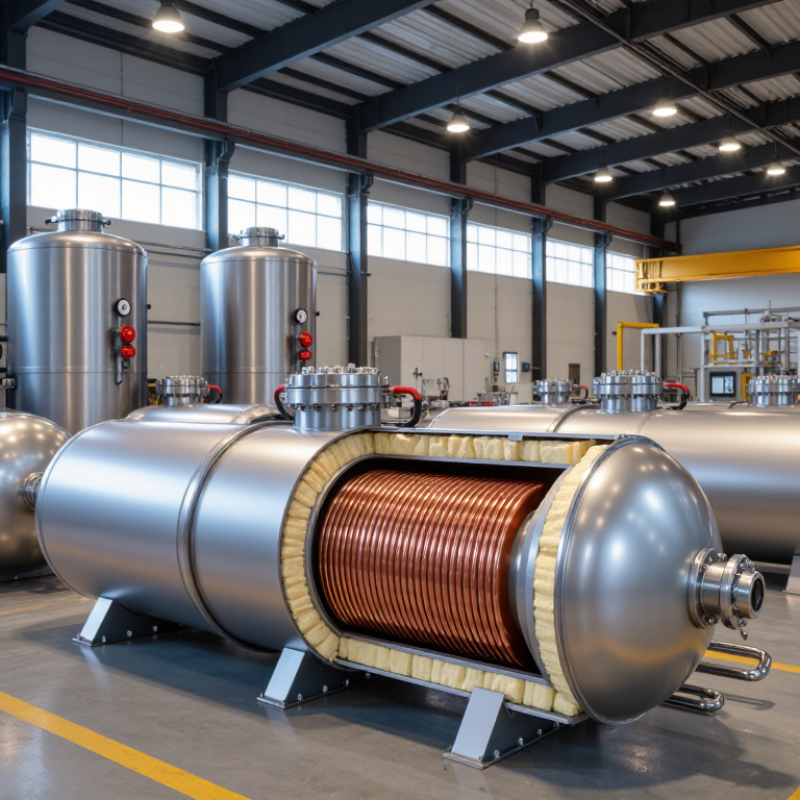
Production capability varies widely. Some manufacturers focus on standard tank sizes, while others handle custom connections, internal coils, or different port layouts. Buyers can ask for material specifications, pressure-test records, insulation details, and sample inspection photos. Small details matter. A poorly placed drain, for example, can make routine maintenance awkward. Factory claims should be checked against documented test procedures, not assumed from capacity alone.
Tips: Compare tanks using the same operating conditions, including water temperature and pressure. Confirm dimensions, connection locations, and corrosion protection before approving a sample. Ask how defects are recorded and how production batches are checked. A neat sample is useful, but it does not prove every unit will match. That gap deserves attention.
This overview compares common product configurations and manufacturing considerations, not individual companies or brands. Figures are indicative specification ranges found in the market; actual limits vary by model, system design, and applicable local requirements.
| Product Segment | Typical Storage Capacity | Common Tank Construction | Typical Rated Working Pressure | Common Insulation | Typical Application | Key Specification to Verify |
|---|---|---|---|---|---|---|
| Residential integrated heat-pump water heater | Approximately 150–300 L | Vitreous-enamel-lined steel or stainless steel | Commonly 0.6–0.8 MPa | Foamed polyurethane (PU) | Domestic hot water for houses and apartments | Usable hot-water volume, recovery time, noise level, and operating ambient-temperature range |
| Compact residential or apartment system | Approximately 80–150 L | Enamel-lined steel or stainless steel, depending on model | Model-specific; check the nameplate and product documentation | Foamed PU | Smaller households and locations with limited installation space | Dimensions, minimum installation clearances, and hot-water delivery at the specified draw-off rate |
| Split-system storage tank | Approximately 150–500 L | Enamel-lined steel or stainless steel | Commonly designed for pressurized domestic-water systems; verify the rated value | Foamed PU, with thickness set by the product design | Installations where the heat-pump unit and storage tank are separated | Coil heat-transfer area, connection sizes, sensor arrangement, and compatibility with the heat-pump unit |
| Commercial storage tank for heat-pump systems | Approximately 300–1,000 L or more | Enamel-lined steel or stainless steel; larger projects may use project-specific designs | Specified for the system design; confirm the vessel rating and safety-device settings | PU foam or other insulation specified for the installation | Hotels, schools, residential buildings, and other higher-demand sites | Peak-hour demand, recovery capacity, recirculation design, drainage, and service access |
| Solar-ready or multi-energy storage tank | Approximately 200–1,000 L or more | Usually enamel-lined steel or stainless steel, with one or more heat-exchange coils | Model- and circuit-specific | Foamed PU or project-specified insulation | Systems combining a heat pump with solar thermal or another heat source | Number and area of coils, hydraulic layout, sensor ports, and control-system compatibility |
| Export-oriented OEM or project-specified tank | Selected to match the buyer’s system and target market | Material, lining, connections, and finish defined by the approved specification | Must match the destination market’s design requirements and product documentation | Specified by the order and applicable energy-performance requirements | Private-label supply, project procurement, and overseas distribution | Material certificates, pressure and leakage test records, packaging, labeling, and destination-market compliance |
When evaluating Chinese heat pump water tank manufacturers, look beyond price and advertised capacity. The IEA’s The Future of Heat Pumps (2022) reported global heat pump sales growth of about 11% in 2022. The European Heat Pump Association’s 2023 market report recorded roughly 3 million European sales that year, up 38%. These figures point to rising demand, but they do not prove a tank is durable.
Ask for material specifications, weld inspection records, and documented pressure, leak, corrosion, and thermal-cycle test results. Check insulation thickness and measured heat loss, not just claims of “high efficiency.” Request drawings showing connections and dimensions; small mismatches can complicate installation. Confirm the tank’s operating limits suit the selected heat pump and local water conditions. Details matter.
Review batch traceability, warranty terms, spare-part availability, and response times in writing. A polished specification sheet is not proof. One often-overlooked weakness is service support after shipment. If a factory cannot explain its test method or share representative records, pause and investigate. Independent test reports can help, though their scope may not match your exact model.
China Best Heat Pump Water Tank Manufacturers
How to Compare Products, Quality, and After-Sales Support
Compare tanks as part of a complete heating system, not as isolated cylinders. The International Energy Agency’s 2022 report, The Future of Heat Pumps, notes that heat pumps are typically three to five times more energy-efficient than gas boilers. That advantage depends on a well-matched tank, controls, and operating temperatures. Ask suppliers for usable storage volume, standing heat loss, coil area, and compatibility data. Request test conditions, too. Numbers without conditions are hard to compare.
Inspect details that affect service life: lining material, weld finish, insulation thickness, and corrosion protection. A sample cutaway or clear production photos can reveal more than glossy brochures. Ask how each unit is pressure-tested and how defects are recorded. Paper specifications still miss things. I would not treat a long warranty as proof of quality; exclusions and labor coverage matter.
After-sales support deserves equal weight. Confirm response times, spare-part availability, installation guidance, and who handles warranty claims in your market. Ask for a written escalation path and examples of common replacement parts. A tank may perform well in a factory test, yet become costly if a sensor or fitting takes weeks to arrive. Compare support commitments in writing, then check them with recent customers where possible.
A reliable heat pump water tank supplier in China should be judged by evidence, not a polished catalog. Request technical drawings that specify tank capacity, working pressure, materials, insulation, and connection sizes. Check that test reports match the exact model being quoted, and verify the issuing laboratory where possible. Small details matter.
Ask how the supplier tests for leaks and controls weld quality. If practical, inspect a production sample or arrange an independent factory audit. Look closely at weld seams, ports, surface finish, and insulation coverage. Request records showing how materials and finished units are traced by batch. A visit can reveal useful details, but it cannot prove every production run is consistent.
Discuss expected operating conditions and confirm compatibility with your heat pump system before ordering. Get written answers about lead times, warranty coverage, replacement parts, and how defects are handled. Compare responses from technical staff, not just sales representatives. Vague answers deserve follow-up. Even careful checks have limits; I would reassess a supplier if promised specifications change between quotation and production.
Phone: (256) 845-1255 or (256) 845-4493
Fax: (256) 845-1321 or (256) 845-4468
© 2025 Heritage Wire Harness, LLC