Blog

Best Traffic VMS LED Display Types in 2026?

Choosing the best traffic VMS LED display in 2026 is not simply a brightness contest. It is a decision about readable messages, road conditions, installation time, and reliable operation. INRIX’s 2024 Global Traffic Scorecard estimated that U.S. drivers lost an average of 43 hours to congestion that year. That figure gives agencies a practical reason to deliver useful warnings before drivers reach a queue, lane closure, or diversion.

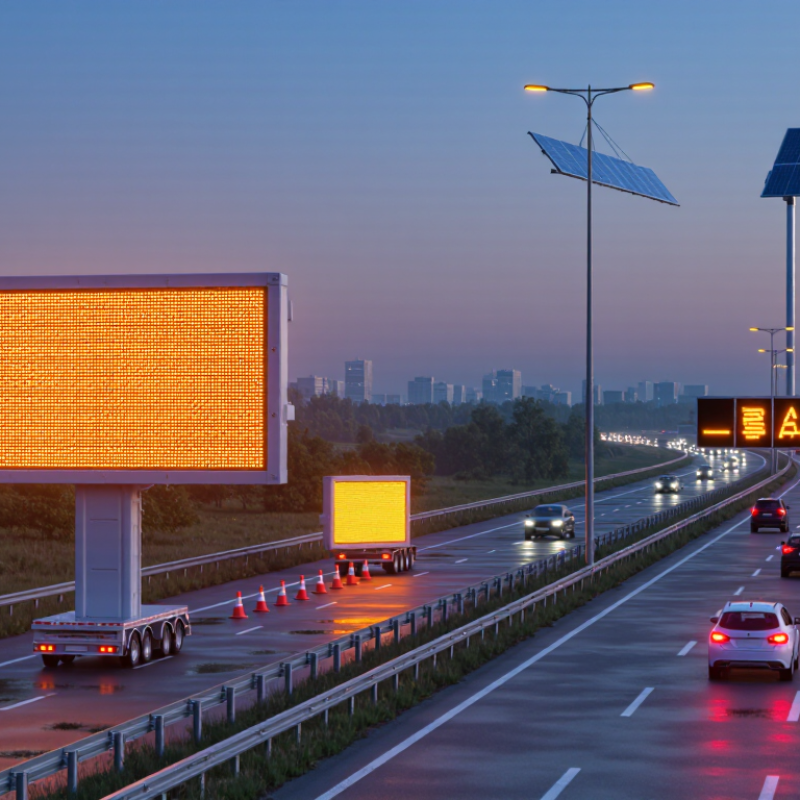
As INRIX transportation analyst Bob Pishue has emphasized in the report’s analysis, congestion carries measurable time and economic costs. For VMS planners, the implication is clear: a sign should communicate information drivers can use, not add visual clutter. The FHWA’s 11th Edition Manual on Uniform Traffic Control Devices provides authoritative guidance for traffic-control devices, including changeable message signs. Agencies should also consider viewing distance, ambient light, message length, power access, and maintenance conditions. A wet highway at dusk is a different test from a sunny daytime approach.

The main options include fixed full-matrix LED signs, portable trailer-mounted displays, lane-control signs, and solar-powered units. Each serves a different job. Fixed displays suit recurring corridors; portable signs can support temporary work zones; lane-control displays give drivers lane-specific instructions. No type wins everywhere. This guide compares their visibility, flexibility, operating demands, and best-fit applications, while noting where performance claims need careful checking. Specs can look impressive on paper. Field conditions decide more.
Best Traffic VMS LED Display Types in 2026?

What Is a Traffic VMS LED Display?

A traffic VMS LED display is an electronic roadside sign that shows changing messages to drivers. VMS means variable message sign. Unlike a fixed sign, it can present different information as traffic conditions change. Common messages include lane closures, travel times, road work, and weather warnings.

The display uses rows of light-emitting diodes, or LEDs, arranged to form letters, numbers, and simple symbols. A controller sends approved messages to the sign, while sensors or traffic operators may provide updated information. Some units are mounted permanently above a roadway; portable versions can be placed near work zones. From the driver’s perspective, the details matter: a message must be readable in daylight, at night, and from a safe distance. Short wording helps.

Keep it clear. More brightness is not always better. Glare, viewing angle, rain, and the spacing between LEDs can affect readability. A technically capable sign can still confuse drivers if its message is crowded or changes too often. That part is easy to overlook. Operators also need to check that displayed information is current; a stale travel time can be worse than no estimate. VMS displays support communication, but they do not replace clear road design or attentive driving.

Best Traffic VMS LED Display Types in 2026? What Is a Traffic VMS LED Display?

A traffic VMS (variable message sign) is an electronic roadside sign that displays changing traffic information. LED VMS signs use light-emitting diodes to show messages and symbols. The right display type depends on the road, viewing distance, and message needs.

How to read this chart: The U.S. MUTCD specifies an 18-inch minimum character height for changeable message signs (CMS). The 24-inch bar is an illustrative larger-character design benchmark, not a universal requirement. Larger characters can help improve legibility at greater viewing distances; verify applicable local standards when selecting a sign.

Source: Federal Highway Administration, Manual on Uniform Traffic Control Devices (MUTCD), 11th Edition.

How Are Traffic VMS LED Displays Classified?

Traffic VMS LED displays are classified by how they are installed, how they present messages, and what colors they show. Fixed units sit beside or above a roadway; portable units are mounted on trailers and can be repositioned near temporary work zones. Placement affects viewing distance, mounting height, and the time drivers have to read a message.

Display format is another useful distinction. Character-based panels show preset text, while full-matrix displays arrange pixels to create more flexible text and symbols. LED color capability ranges from single-color to multicolor. More colors do not automatically improve communication. Contrast, brightness, viewing angle, and clear wording matter more on a rainy night. The categories can overlap, so a portable sign may also use a full-matrix display.

These distinctions matter amid persistent congestion. The Texas A&M Transportation Institute’s 2023 Urban Mobility Report estimated that congestion caused 7 billion hours of delay in 2022. That figure is not a measure of VMS performance, but it shows why timely road information matters. When specifying a unit, agencies should match its format and mobility to the road’s speed, sightlines, and message needs. A technically advanced panel can still be poorly suited to its location.

Which LED Display Types Are Used for Traffic VMS in 2026?

Traffic VMS installations in 2026 commonly use three LED display formats: monochrome matrix, full-color matrix, and character or line matrix. Monochrome amber matrix signs show text and simple symbols, such as lane closures or travel times. Their familiar appearance and clear contrast suit many roadside applications. Not always the best fit.

Full-color matrix displays can show more detailed diagrams, route information, and color-coded warnings. They offer flexibility, but extra colors do not automatically improve readability. Engineers need to consider viewing distance, sunlight, viewing angle, and the time drivers have to read each message. A sign beside a fast-moving highway may need larger, simpler characters than one approaching a slower junction.

Character or line matrix displays use fixed character shapes or rows of pixels to present concise text. They can be a practical choice where messages follow a predictable format. Lane-control displays are another specialized type, using symbols such as arrows or crosses to indicate lane status. LED package design, including DIP and SMD, is a separate consideration from display format. Site testing still matters. Glare, weather, dirt, and installation angle can change how legible a sign appears; specifications alone cannot settle every detail.

How Do Traffic VMS LED Display Types Compare?

Traffic VMS displays mainly differ in pixel resolution, message flexibility, and power demand. Full-matrix LED signs can show text, arrows, and simple graphics. They suit complex lane changes or incident warnings, but need more pixels and careful brightness control. Character-matrix signs use fixed letter shapes. They are efficient for short, repeatable messages, though graphics and unusual wording are limited. Line-matrix units sit between these options, balancing readable text with moderate flexibility.

FHWA’s 2023 Manual on Uniform Traffic Control Devices recommends keeping changeable-message signs to three phases or fewer, with a total cycle no longer than eight seconds. That limit matters: a highly flexible display is not automatically more useful if drivers cannot read it in time. On a wet approach, large amber characters may be easier to scan than a dense graphic. It is a trade-off.

Portable trailer-mounted VMS adds deployment flexibility for roadworks or temporary incidents. Fixed overhead displays, by contrast, provide consistent coverage at known decision points. The right comparison includes viewing distance, lane geometry, ambient light, and maintenance access—not just pixel count. A full-matrix sign can look impressive in a specification sheet and still underperform when placed too close to a curve. That detail is easy to miss.

Best Traffic VMS LED Display Types in 2026? - How Do Traffic VMS LED Display Types Compare?

VMS Type Display Characteristics Main Advantages Key Considerations Common Applications
Amber monochrome matrix Uses amber LEDs to form changeable text and, on suitable displays, simple symbols. Clear, familiar presentation for warnings and short messages; a straightforward option when color graphics are unnecessary. Cannot use color to distinguish message elements. Readability depends on sign size, character design, viewing distance, and ambient conditions. Roadwork alerts, incident warnings, travel-time messages, and general-purpose changeable-message signs.
Two- or three-color matrix Combines selected LED colors, commonly including amber and red and, on some systems, green. Can emphasize selected symbols or message elements with color while retaining changeable-message flexibility. Color availability and permitted use vary by sign design and local requirements. It does not provide the full palette of an RGB display. Traffic management messages that benefit from a limited set of colors or colored symbols.
Full-color RGB matrix Uses red, green, and blue LEDs to produce a broad range of colors, graphics, and pictograms. Supports more varied visual information and can present graphics alongside text where approved. Requires careful control of brightness, contrast, and message legibility. Allowed colors, graphics, and use are subject to applicable traffic-sign rules. Locations where approved symbols or graphic messages add useful information to driver communication.
Character or line-matrix LED Arranges LEDs in character positions or fixed lines, typically for text and a limited set of symbols. A defined layout can make standard messages easy to present consistently. Less flexible than a full-matrix display for changing layouts, nonstandard text, or custom graphics. Sites with a predictable set of approved messages and a consistent sign layout.
Portable trailer-mounted VMS A mobile deployment format; the LED display itself may use monochrome, multicolor, or matrix technology. Can be relocated as work zones and temporary traffic conditions change; many units include a power source and a lifting mechanism. Requires a suitable placement area, setup, power planning, and appropriate traffic protection. Visibility and stability depend on installation conditions. Temporary roadworks, event traffic, detours, and short-term incident management.
Fixed roadside or overhead VMS A permanent installation format that can use different LED colors and matrix configurations; mounted beside or above the roadway. Provides a stable location for recurring route, congestion, incident, or lane-related messages. Requires suitable structures, power and communications, maintenance access, and site-specific engineering. Message layout must suit the viewing position. Highways, tunnels, approaches to managed lanes, and other locations with ongoing traffic-management needs.

Note: LED color configuration and mounting format are different ways of classifying a VMS. Actual sign dimensions, permitted messages, colors, and performance requirements depend on the applicable jurisdiction and project specifications.

How to Choose the Right Traffic VMS LED Display?

How to Choose the Right Traffic VMS LED Display?

Choose the display for its road speed, viewing distance, and message length—not just its pixel count. FHWA’s 11th Edition MUTCD recommends character heights of at least 18 inches for freeway applications and 12 inches on other roads. Treat these as practical baselines, then check sightlines from approaching lanes. Drivers need time to read, decide, and react.

Full-matrix LED displays support flexible symbols and text, while more limited displays can suit short, repeatable warnings. Compare pixel pitch with the distance at which drivers must recognize symbols; finer pitch is not automatically better. Ask for nighttime and direct-sunlight contrast measurements, plus brightness controls that prevent glare. FHWA’s 2023 MUTCD also emphasizes legible, understandable messages, so test actual wording on the road—not only in a showroom.

Check ingress protection, temperature range, wind loading, power draw, and remote fault reporting against the installation site. A roadside cabinet faces dust, rain, heat, vibration, and occasional maintenance delays. Confirm spare-part access and safe service procedures before purchase. A perfect-looking panel can still be the wrong choice. I would also question any proposal that promises visibility without stating test conditions; that detail is easy to overlook, and costly later.

Go to Top