
Choosing China’s best COB fine pitch LED display supplier requires more than a polished website. The real test begins with the screen. In a control room, a 0.9 mm display should show crisp text, smooth skin tones, and stable blacks. Engineers also inspect cabinet seams, module flatness, and service access. These details reveal manufacturing discipline. Yet “best” depends on your application, budget, viewing distance, and support expectations. There is no universal winner.
A credible supplier should explain its COB process clearly. Chip placement, encapsulation, calibration, and protection must follow controlled procedures. Ask for measured brightness, grayscale performance, refresh rate, color consistency, and failure data. Do not accept vague claims. Request a live demonstration, aging-test records, and samples from the same production line. Experienced teams can discuss front maintenance, thermal design, electromagnetic compatibility, and spare-module planning without avoiding difficult questions. Factory audits, quality certificates, and traceable inspection reports add confidence, but paperwork alone proves little.
This guide examines how to compare Chinese COB fine pitch LED manufacturers through practical evidence. We focus on factory capability, display performance, project experience, and after-sales reliability. A dependable partner should calculate total cost, not only quote price. Include freight, installation, calibration, training, warranty response, and replacement parts. Some displays look impressive on day one. Long-term stability matters more. Our evaluation remains practical, evidence-based, and open to revision. If a supplier cannot provide verifiable data, treat that gap as a finding, not a minor inconvenience. Good screens deserve careful questions.
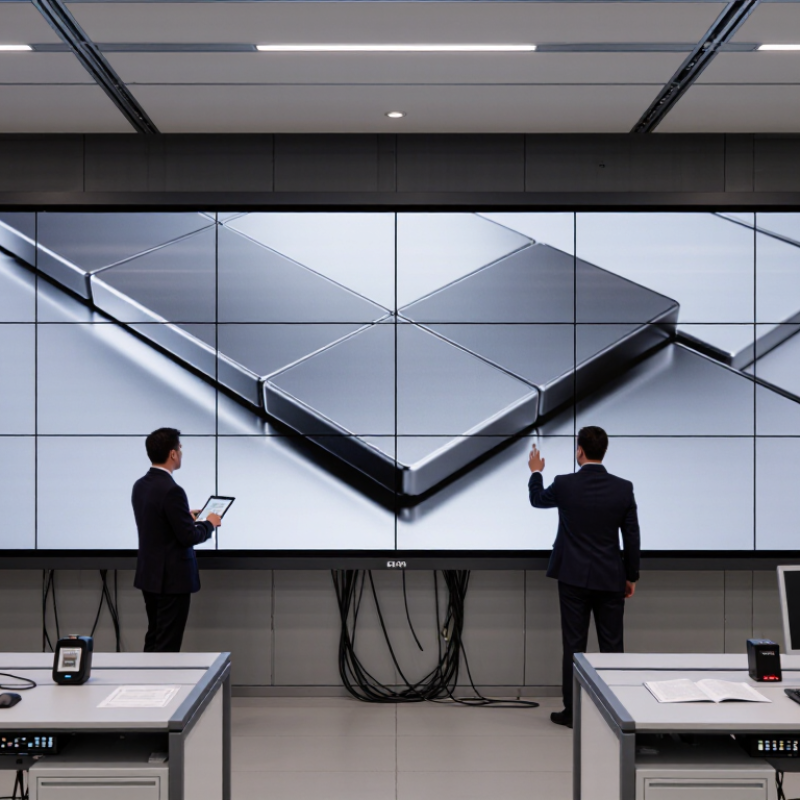
A COB fine pitch LED display places LED chips directly on the circuit board. It removes traditional lamp beads and several exposed solder joints. The result is a flatter surface, tighter pixel spacing, and stronger resistance to accidental contact. Fine pitch usually means a pixel pitch below 2.5 millimeters. Common options include 1.25, 1.5, and 0.9 millimeters. From close range, the image looks more continuous and less like a grid.
The technical benefit is measurable. TrendForce’s 2024 LED Industry Demand and Supply Analysis reported stronger COB adoption in fine-pitch applications, especially for control rooms and premium conference spaces. MarketsandMarkets projects the global LED display market to grow from about 7.4 billion dollars in 2023 to 11.2 billion dollars by 2028. This growth supports demand for compact, high-resolution displays. However, market growth does not guarantee product quality. Thermal design, coating uniformity, grayscale performance, and module tolerances still require inspection.
COB is not magic. A poorly calibrated cabinet can show color differences across one wall. A dusty installation can also reduce perceived contrast. Experienced buyers should request close-up photography, brightness measurements, refresh-rate data, and aging-test records. Ask how damaged modules are repaired. Ask about spare-part consistency. The best supplier is not defined by location alone. It is defined by repeatable manufacturing, transparent test data, and careful after-sales support.
China Best COB Fine Pitch LED Display Supplier?
Key Features of COB Fine Pitch LED Technology
COB fine pitch LED technology places LED chips directly onto the circuit board. This structure reduces exposed connections and creates a smoother display surface. In practical installations, the sealed surface helps resist dust, moisture, and accidental contact. It also supports tighter pixel pitches for control rooms, meeting spaces, and premium digital signage. The result is usually a cleaner image at close viewing distances.
Durability is a major advantage. A properly encapsulated module can tolerate repeated cleaning better than many traditional structures. Its dark surface may improve perceived contrast, especially in dim indoor environments. Heat management still matters, though. Engineers should check cabinet ventilation, operating temperature, and long-term brightness settings before approval. Small details become expensive later.
Not every COB display performs equally. Calibration quality, pixel uniformity, gray-scale control, and service access require careful testing. Ask suppliers for measurement records, aging-test results, and samples viewed from several angles. Installation experience also reveals practical issues, such as uneven walls or difficult front maintenance. We have found that even a technically strong panel can disappoint when processing equipment is poorly matched. That lesson deserves attention. Reliable suppliers should explain limitations clearly, not only promote fine pitch and high contrast.
COB fine-pitch LED displays place LED chips directly onto the printed circuit board. The resulting integrated surface supports compact pixel pitches, improved surface protection, and high pixel density for close-viewing applications.
Pixel density is calculated from the pixel pitch using the formula: 1,000,000 ÷ pixel pitch². Values are theoretical pixels per square metre and do not represent any specific company or brand.
Choosing a Chinese COB fine-pitch LED display supplier requires more than comparing quotations. Grand View Research valued the global LED display market at approximately USD 7 billion in 2023. Its report also projects continued growth through 2030. This pressure attracts new factories, but production experience varies widely.
I evaluate the supplier through samples, factory records, and technical evidence. Ask for pixel uniformity data, dead-pixel policy, brightness consistency, and module replacement time. Request a full BOM, not only a glossy specification sheet. For fine-pitch products, inspect a 0.9 mm or 1.2 mm sample from one production batch. Check solder joints under magnification. Measure grayscale stability, color temperature, and cabinet flatness after thermal cycling. The supplier should explain its COB coating process and repair method clearly. If answers remain vague, that is useful evidence.
TrendForce’s 2024 LED Display Market Outlook highlights the growing adoption of fine-pitch and direct-view LED solutions in professional spaces. However, market growth does not prove supplier reliability. ISO 9001 certification supports process control, but it cannot replace independent testing. IEC 62368-1 compliance is also important for product safety and installation review. I would still request an accredited laboratory report. Factory claims can be incomplete.
Tips: Compare three suppliers using the same test conditions. Require a written warranty, spare-module ratio, and brightness-aging plan. Visit the factory if possible. One video call is not enough. Record every promise in the contract.
| Evaluation Dimension | Recommended Reference Range or Requirement | Why It Matters | How to Verify the Supplier |
|---|---|---|---|
| Pixel Pitch | Approximately 0.7–1.5 mm for close-view indoor applications; 1.5–2.5 mm for larger rooms and viewing distances. | A smaller pitch provides higher image detail but normally increases cost and installation requirements. | Request a calibrated sample cabinet and assess image quality from the intended minimum viewing distance. |
| COB Encapsulation Quality | Uniform protective coating with no visible bubbles, cracks, pinholes, color patches, or exposed solder points. | High-quality encapsulation improves surface protection, cleanability, and resistance to accidental impact. | Inspect the module under uniform lighting and review production quality-control records. |
| Brightness | Typically about 600–1,200 nits for indoor fine-pitch applications, depending on ambient light. | Sufficient brightness maintains readability without causing unnecessary glare or power consumption. | Verify measured brightness at the specified calibration setting, not only the maximum value. |
| Refresh Rate | At least 3,840 Hz is commonly preferred for camera-facing environments; higher values may be selected for demanding broadcast use. | A high refresh rate helps reduce scan lines, flicker, and interference in photographs and video recordings. | Test the display with professional cameras at different shutter speeds and brightness levels. |
| Grayscale Performance | 16-bit or higher internal processing is commonly specified for smooth gradients and detailed dark scenes. | Good grayscale reproduction prevents banding and preserves shadow detail in professional content. | Display dark gradient test patterns and compare low-gray uniformity at multiple brightness levels. |
| Color Uniformity | No obvious brightness or chromatic variation between modules; factory calibration data should be available. | Uniform color is essential when multiple cabinets form one seamless image. | Use white, gray, red, green, and blue test screens across the complete display area. |
| Contrast and Black Level | A high contrast specification is useful, but real black-level performance should be judged in the installation environment. | Deep blacks improve perceived contrast, especially in control rooms, studios, and premium meeting spaces. | Evaluate black, near-black, and mixed-content test patterns under normal ambient lighting. |
| Viewing Angle | Common professional specifications are approximately 160° horizontal and 160° vertical, subject to the LED design. | A wide viewing angle helps maintain consistent color and brightness for audiences positioned off-axis. | Observe the screen from multiple horizontal and vertical angles and check for color shift. |
| Cabinet Flatness and Seam Quality | Minimal cabinet-to-cabinet height difference and no visible bright or dark lines at normal viewing distance. | Mechanical precision directly affects the visual continuity of a fine-pitch display. | Assemble several cabinets and inspect seams using a uniform gray or white test image. |
| Reliability and Aging Test | A documented burn-in process, commonly 24–72 hours or longer, with results retained for each production batch. | Aging tests can identify early-life failures before shipment and reduce installation problems. | Request test procedures, sample records, failure handling rules, and acceptance criteria. |
| Ingress and Surface Protection | For indoor products, confirm the declared protection level; higher protection may be required in dusty, humid, or public environments. | Protection against dust, moisture, and contact can extend service life and simplify maintenance. | Check the formal test report and confirm that the tested structure matches the supplied product. |
| Power Consumption | Compare both average and maximum power consumption; actual values vary with brightness, content, and configuration. | Power data affects electrical design, operating cost, heat management, and backup-power requirements. | Measure a representative cabinet with a power meter at several brightness and content settings. |
| Calibration System | Cabinet-level and module-level calibration with data backup and replacement-module matching capability. | Effective calibration reduces color differences and simplifies future maintenance. | Ask for calibration files, software demonstrations, and the procedure for replacing a failed module. |
| Compliance Documentation | Relevant electrical safety, electromagnetic compatibility, environmental, and material declarations for the target market. | Complete documentation supports customs clearance, site approval, and legal market access. | Verify certificate scope, model number, testing laboratory, validity, and consistency with the quotation. |
| Warranty and Spare Parts | Clear written warranty terms, defined response times, and recommended spare modules, power supplies, and receiving cards. | Fine-pitch systems require compatible replacement parts to preserve color and mechanical consistency. | Review exclusions, shipping responsibility, repair procedures, and long-term parts availability. |
| Production Capability | Stable process control, traceable component batches, documented inspection stages, and capacity aligned with the project schedule. | Consistent production is more important than nominal capacity for large, uniform LED walls. | Conduct a factory audit or live video inspection and request a project-specific quality-control plan. |
| Technical Support | Pre-sales design assistance, installation guidance, remote troubleshooting, and commissioning support in the required time zone. | Responsive support can reduce downtime and prevent configuration errors during installation. | Test response quality with technical questions and request a sample commissioning or service workflow. |
| Total Cost of Ownership | Evaluate purchase price together with shipping, installation, power, maintenance, spare parts, software, and replacement costs. | The lowest quotation may not provide the lowest cost over the full operating period. | Compare suppliers using the same technical specification, warranty scope, delivery terms, and service assumptions. |
Choosing a COB fine-pitch LED supplier requires more than comparing pixel pitch and price. Fortune Business Insights valued the global LED display market at USD 7.57 billion in 2023, showing strong demand but also intense competition. A serious supplier should provide measured data for brightness, contrast, grayscale, refresh rate, and pixel failure rate. Ask for a complete test report, not a sales promise. Inspect a 1–2 square meter sample under camera conditions, where scan lines and color inconsistency become visible.
Service quality is equally important. Confirm the supplier’s module tolerance, receiving inspection process, spare-part ratio, and repair method. COB surfaces resist minor impact and dust, but damaged modules can be harder to rework. That trade-off is easy to overlook. Request installation guidance, cabinet flatness records, thermal test results, and response-time commitments. Independent testing against applicable IEC safety and EMC requirements adds credibility. Certification alone does not prove long-term reliability.
Compare warranty terms carefully. Does coverage include dead pixels, brightness decay, and repeated module failure? Field experience suggests that unclear exclusions create more trouble than the original purchase price. Ask for references from comparable indoor environments, such as control rooms or broadcast studios. A supplier may offer excellent samples yet lack production consistency. That possibility deserves a factory audit. Short videos are not enough. You need traceable records, stable communication, and service engineers who can explain problems without hiding them.
Choosing the Best COB Fine Pitch LED Display Supplier in China requires more than comparing price lists. MarketsandMarkets projects the global LED display market to grow from about USD 7.1 billion in 2023 to USD 11.8 billion by 2028. This growth increases supplier choices, but also increases quality differences.
Request a live COB sample before signing a contract. Check pixel uniformity, cabinet flatness, refresh rate, grayscale performance, and surface protection under bright light. A reliable supplier should provide production records, aging-test results, optical measurements, and traceable component information. TrendForce industry reports continue to highlight fine-pitch LED demand in control rooms, corporate spaces, and premium commercial installations. Therefore, ask whether the supplier has completed projects with similar viewing distances and operating hours.
Visit the production line, if possible. Observe clean-room controls, automated placement, repair procedures, and final inspection. Confirm compliance documents for the destination market, warranty coverage, spare-module availability, and response times for remote support. COB technology can reduce pixel damage risk, yet poor encapsulation or weak thermal design may create uneven brightness later. No supplier is perfect. A careful buyer should record small defects, not hide them behind marketing language. Independent third-party testing can also expose gaps between a sample and mass production. Supplier selection becomes more dependable when technical data, field references, and service commitments agree.
Phone: (256) 845-1255 or (256) 845-4493
Fax: (256) 845-1321 or (256) 845-4468
© 2025 Heritage Wire Harness, LLC