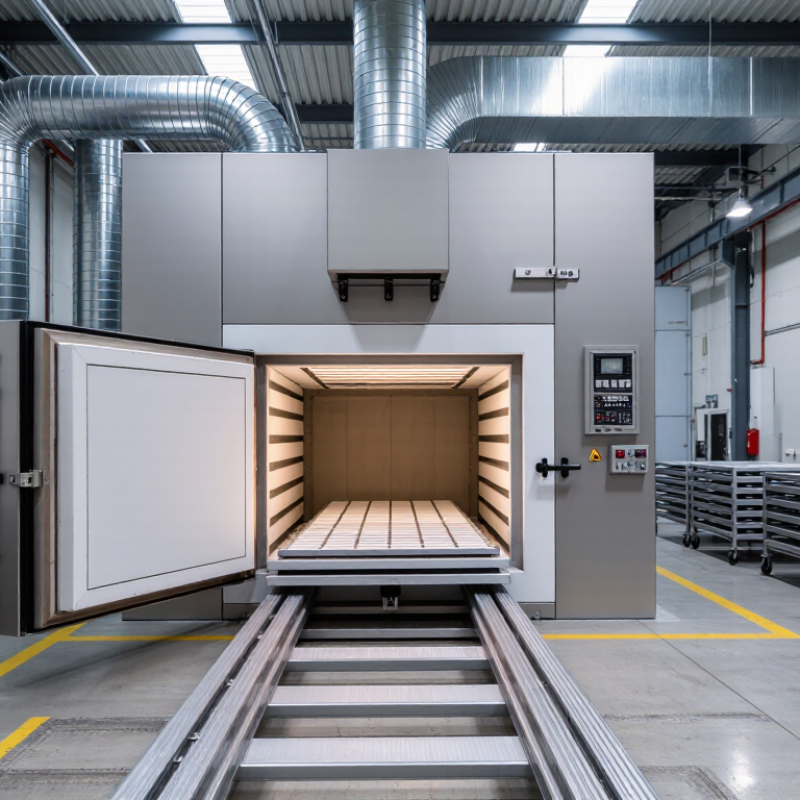
Choosing the China best Hardening Oven manufacturer requires more than comparing prices or polished factory photographs. Heat treatment results depend on temperature uniformity, airflow design, insulation quality, control accuracy, and after-sales support. A reliable manufacturer should explain these details clearly, using practical data rather than broad promises.
In real production, small differences matter. A door that seals poorly can waste energy and disturb the heating cycle. Uneven airflow may leave metal parts with inconsistent hardness. Experienced suppliers usually discuss chamber size, operating temperature, heating elements, furnace atmosphere, loading methods, and production volume before recommending a model. They should also provide inspection records, control-system information, installation guidance, and a realistic maintenance plan.
Ask difficult questions.
A dependable Hardening Oven manufacturer welcomes technical review. Evidence matters more than confident language. Buyers can request factory videos, equipment drawings, sample test reports, and references from comparable industries. Certifications may support credibility, but they do not replace performance verification. Site acceptance testing remains important.
The best choice may not be the cheapest offer. It should be the supplier that understands your process and documents its responsibilities. Still, every claim deserves careful checking. Even an experienced manufacturer can misunderstand an application when specifications are incomplete. This guide examines manufacturing capability, customization, safety design, energy efficiency, quality control, and service reliability. It aims to help readers compare Chinese suppliers with practical judgment, not assumptions.
A hardening oven heats steel parts to a controlled austenitizing temperature. This changes the metal’s internal structure before quenching. The selected temperature depends on the steel grade, part thickness, and required hardness.
Inside the chamber, electric heating elements raise the temperature gradually. Fans circulate hot air and reduce cold spots around the load. Thermocouples measure the actual part temperature, not only the chamber temperature. A calibrated controller then adjusts heating power and holding time. Small gaps matter. Parts need enough space for stable airflow.
After soaking, operators remove the parts and quench them in a suitable medium. The rapid cooling forms a harder structure, but it can also create distortion or cracking. Tempering often follows hardening to reduce internal stress and improve toughness.
In my experience, loading mistakes cause many uneven results. A perfect recipe on paper can still fail when parts touch, airflow is blocked, or sensors are poorly positioned.
Reliable operation requires documented recipes, regular temperature checks, and careful records for every batch. Operators should verify uniformity with appropriate testing equipment and follow the steel supplier’s technical data.
Hardening ovens may use air, protective gas, or vacuum conditions, depending on surface requirements. Clean chambers help prevent scale and contamination. The process is precise, but never completely automatic. Human judgment still matters.
China Best Hardening Oven Manufacturer?
Key Features of China’s Leading Hardening Oven Manufacturers
China’s leading hardening oven manufacturers focus on stable heat, accurate control, and practical production design. In real workshops, temperature uniformity matters more than impressive brochure numbers. A well-built oven keeps hot spots under control across the chamber. This protects metal parts from uneven hardness and unwanted distortion.
Reliable manufacturers use insulated steel panels, durable heating elements, and industrial-grade sensors. Digital controllers should record temperature changes clearly. Operators need simple settings, especially during long production cycles. Safety systems also deserve close inspection. Door interlocks, over-temperature protection, alarms, and emergency stops should work without hesitation. Small failures can interrupt an entire shift.
Customization is another important feature. Tray size, working temperature, airflow, loading method, and fuel choice may differ between factories. Experienced suppliers usually ask about part shape and daily capacity before suggesting a model. That is a good sign. Some sellers may offer attractive specifications but provide little process guidance. I would question that. No oven is perfect. Energy use can rise when insulation ages or doors remain open too long. After-sales support, spare parts, installation guidance, and maintenance training should be checked before purchase. Factory testing records and clear technical documents also make performance claims easier to trust.
China Best Hardening Oven Manufacturer?
Evaluating a hardening oven requires more than checking its maximum temperature. In daily production, temperature stability matters most. Ask for a temperature uniformity survey across the working chamber. A reliable oven should heat corners, shelves, and the center evenly. A 10°C difference can affect hardness, distortion, and repeatability. Request calibration records for thermocouples and controllers. These documents show whether measurements are trustworthy, not merely impressive.
Inspect the heating elements, insulation, airflow path, and door seal. Thick insulation reduces heat loss and protects energy efficiency. A tight door should close smoothly, without visible gaps. Watch the oven during a full load test. Empty-chamber results can look excellent but may change with heavy baskets. The control system should record temperature curves and alarms clearly. Operators need simple adjustments, especially when production conditions change. I have seen technically strong ovens underperform because loading habits were never tested. That weakness deserves honest discussion.
Tips: Ask for reference data from similar loads. Check recovery time after opening the door. Confirm spare-part availability and service response. Inspect welds and internal surfaces closely. Small defects can become expensive later. No test is flawless. Compare factory data with an independent verification when possible.
| Evaluation Dimension | Key Specification or Test Point | Practical Reference Benchmark | Why It Matters | Recommended Verification Method |
|---|---|---|---|---|
| Temperature Range | Maximum operating temperature and usable working range | Common hardening applications typically require approximately 800–1,100°C, depending on the steel grade and process. | The oven must reach and maintain the temperature required for austenitizing without operating continuously at its absolute limit. | Review the rated temperature, working temperature, heating-element material, and a witnessed heat-up test. |
| Temperature Uniformity | Temperature difference between measured points inside the effective working zone | A well-designed industrial oven commonly targets approximately ±5–10°C after stabilization, subject to size and load conditions. | Uniform temperature helps prevent soft spots, excessive grain growth, distortion, and inconsistent hardness. | Perform a temperature uniformity survey with calibrated thermocouples at multiple positions and load levels. |
| Temperature Control Accuracy | Difference between the programmed setpoint and the actual controlled temperature | A practical target for many heat-treatment applications is around ±1–3°C during stable operation. | Accurate control improves repeatability from batch to batch and reduces the risk of overheating or underheating. | Compare the controller reading with an independent calibrated temperature recorder during a steady-state cycle. |
| Heating Rate | Time required to reach the process temperature with an empty and loaded chamber | The actual rate varies with chamber size, load mass, insulation, and power; loaded performance is more important than empty-chamber speed. | A suitable heating rate supports production efficiency while limiting thermal stress and distortion of workpieces. | Record time-temperature curves for both empty-chamber and representative full-load tests. |
| Temperature Recovery | Time needed to return to the process range after door opening or loading | Recovery should be evaluated against the oven size and load; stable recovery without prolonged overshoot is preferred. | Fast, controlled recovery reduces cycle variation and improves throughput in repeated production. | Open the door for a defined period, introduce a standard load, and record the recovery curve and overshoot. |
| Insulation Performance | Insulation construction, heat loss, external surface temperature, and thermal bridging | External surfaces should remain within applicable workplace-safety requirements; the exact limit depends on local regulations and operating conditions. | Effective insulation lowers energy consumption, protects operators, and improves temperature stability. | Use thermal imaging or contact measurements at accessible surfaces during normal operation and inspect insulation joints. |
| Airflow and Circulation | Fan arrangement, airflow direction, circulation rate, and load coverage | Forced circulation is generally preferred for large or densely loaded chambers when uniformity is critical. | Proper airflow minimizes hot and cold zones and helps expose each part to comparable thermal conditions. | Review airflow design and compare thermocouple readings in corners, center areas, near the door, and around the load. |
| Load Capacity and Effective Zone | Maximum permitted load, usable chamber dimensions, and effective heating zone | The effective working zone should be defined separately from the total internal chamber volume. | Overloading can block airflow, extend heating time, and cause temperature non-uniformity even when the oven is within its nominal rating. | Confirm usable dimensions, maximum load mass, loading layout, and performance with a representative production load. |
| Atmosphere Protection | Availability of air, inert-gas, or controlled-atmosphere operation and sealing quality | Atmosphere selection should match the material, surface-finish requirements, and allowable oxidation or decarburization. | Controlled atmosphere can reduce scale formation and surface chemistry changes during heating. | Check door seals, gas connections, flow controls, pressure stability, and surface condition after a trial cycle. |
| Door and Chamber Sealing | Door construction, gasket material, locking method, and leakage prevention | The door should close evenly with no visible gaps, abnormal heat leakage, or unstable temperature near the opening. | Good sealing improves energy efficiency, operator safety, and atmosphere control. | Inspect the gasket and frame, measure accessible surface temperatures, and conduct a smoke or leakage check where appropriate. |
| Controller and Data Recording | Programmable recipes, ramp/soak control, alarms, data logging, and export capability | A production-grade system should record setpoint, actual temperature, time, alarms, and batch information. | Traceable records support quality audits, process validation, troubleshooting, and repeatable production. | Run a complete recipe, verify alarm functions, review stored data, and test data export or network connectivity. |
| Safety Protection | Over-temperature protection, door interlock, emergency stop, alarm system, and electrical protection | Safety functions should be independent where practical and comply with applicable electrical and machinery-safety requirements. | Redundant protection limits damage to equipment, workpieces, and personnel if the main control system fails. | Request a documented safety-function test covering over-temperature, door opening, fan failure, power loss, and emergency stop. |
| Energy Efficiency | Installed power, specific energy consumption, standby losses, and heating efficiency | Specific energy use should be compared under the same chamber size, setpoint, load mass, and cycle time; no single value applies to every oven. | Energy performance directly affects operating cost and may indicate insulation or control problems. | Measure electrical consumption during an equivalent production cycle and compare it with the documented rated power. |
| Mechanical and Electrical Build Quality | Frame rigidity, chamber materials, wiring quality, component accessibility, and finish | Industrial construction should use heat-resistant chamber materials, protected wiring, secure terminals, and serviceable components. | Robust construction improves service life and reduces downtime caused by vibration, corrosion, loose connections, or thermal fatigue. | Inspect the chamber, heating elements, fan assembly, control cabinet, cable routing, terminals, and maintenance access. |
| Maintenance and Spare Parts | Access to heating elements, thermocouples, fans, seals, controllers, and commonly replaced parts | Routine inspection and replacement tasks should be possible without dismantling major sections of the oven. | Simple maintenance shortens downtime and lowers the total cost of ownership. | Review the preventive-maintenance schedule, spare-parts list, service procedures, and expected replacement intervals. |
| Documentation and Acceptance Testing | Technical drawings, manuals, wiring diagrams, calibration records, factory tests, and commissioning support | Acceptance documentation should include operating limits, test results, calibration status, and clear installation requirements. | Complete documentation supports safe operation, training, troubleshooting, and future compliance inspections. | Use a written acceptance checklist covering performance, safety, documentation, and operator training. |
| Application Fit | Compatibility with steel grade, part geometry, production volume, hardening method, and downstream quenching process | The oven should be evaluated as part of the complete hardening process rather than as an isolated heating unit. | A technically capable oven may still underperform if its cycle, loading method, or atmosphere does not match the complete process. | Conduct a process trial using representative parts and verify temperature history, surface condition, hardness, distortion, and throughput. |

Note: The benchmark values are general engineering reference ranges. Final acceptance criteria should be established according to the material specification, applicable standards, validated process parameters, chamber size, and actual production load.
China Best Hardening Oven Manufacturer?
Choosing a hardening oven requires more than comparing prices. Manufacturing standards reveal how consistently the equipment will perform. A reliable manufacturer should document temperature uniformity, insulation quality, electrical protection, and pressure testing. Ask for calibration records and inspection procedures. These details matter on the factory floor.
Customization should follow the workload, not vague promises. A supplier may adjust chamber size, heating zones, airflow, loading systems, and control interfaces. For example, a 1,200-millimeter chamber may need different airflow from a compact laboratory unit. Product material, batch weight, heating range, and daily cycles must guide the design. Small details matter.
Technical support is equally important after delivery. Experienced engineers should help with installation, parameter settings, operator training, and fault diagnosis. Clear manuals and accessible spare parts reduce downtime. Remote assistance can help, but it cannot replace practical inspection when unusual noise or uneven heating appears. No oven is perfect. A rushed specification can still create problems, even with careful manufacturing. The best evaluation includes factory experience, measurable testing, honest communication, and support that continues beyond shipment.
This illustrative industrial RFQ model shows how buyers commonly prioritize hardening oven suppliers: thermal performance and compliance with applicable safety standards normally receive the greatest attention, followed by customization, control systems, and technical support. Actual weighting should be adjusted according to process temperature, workload, production volume, and local regulations.
China Best Hardening Oven Manufacturer?
How to Select the Best Chinese Hardening Oven Manufacturer
Selecting a Chinese hardening oven manufacturer requires more than comparing prices. Check the supplier’s engineering experience with your materials, load size, heating range, and production cycle. A serious manufacturer should explain temperature uniformity, insulation design, airflow, and control accuracy in clear technical terms. Ask for test records from similar ovens. Photos alone prove little.
Request drawings, component specifications, inspection procedures, and calibration records before placing an order. The oven should include reliable thermocouples, alarms, over-temperature protection, and documented control settings. Confirm whether the manufacturer can provide factory acceptance testing with your actual workload. This small step can reveal uneven heating or slow recovery.
Look beyond the sales team. Visit the workshop through a verified inspection if possible. Review welding quality, wiring layout, spare-part availability, installation support, and response times. A dependable supplier should also explain export documents, packing methods, and maintenance intervals. I have seen attractive quotations hide weak after-sales service. That risk is easy to underestimate.
No supplier is perfect. Ask how the manufacturer handles design changes, delayed components, or failed tests. Written answers matter. Choose a partner that admits limitations and proposes measurable solutions. The best Chinese hardening oven manufacturer is not always the cheapest option. It is the one that can deliver stable performance, transparent records, and practical support over years of operation.
Phone: (256) 845-1255 or (256) 845-4493
Fax: (256) 845-1321 or (256) 845-4468
© 2025 Heritage Wire Harness, LLC