
Blog

China Top 10 Flour Pouch Manufacturers for Global Buyers

China Top 10 Flour Pouch Manufacturers for Global Buyers introduces reliable packaging partners for flour brands, distributors, and food producers. China remains a major source of flexible food packaging, offering printed bags, laminated films, kraft-paper formats, and custom pouch structures. However, attractive pricing alone does not guarantee a suitable supplier.

This guide evaluates manufacturers through practical purchasing criteria. These include material quality, seal strength, printing accuracy, production capacity, minimum order quantities, and export experience. It also considers food-contact documentation, factory communication, sample support, and delivery consistency. A dependable Flour Pouch should protect powder from moisture, reduce leakage, and remain stable during stacking and transport. Details matter. A weak zipper or uneven heat seal can damage an entire shipment.

The selection process focuses on evidence rather than impressive claims. Buyers should request recent samples, product specifications, test reports, and clear quotations. Factory audits can reveal more than a polished website. Some suppliers may offer excellent printing but limited customization. Others may provide strong technical support but longer lead times. No ranking is permanent. Costs, materials, certifications, and production schedules can change.

Global buyers should compare each manufacturer against their market requirements, filling equipment, and preferred pouch size. A 1-kilogram retail pouch needs different handling than a 25-kilogram bulk bag. Environmental goals also require careful review, because recyclable structures may have different barrier performance. This article offers a practical starting point, not a substitute for supplier verification. Small details often decide large orders.
China Top 10 Flour Pouch Manufacturers for Global Buyers

Flour Pouch Types, Materials, and Packaging Applications

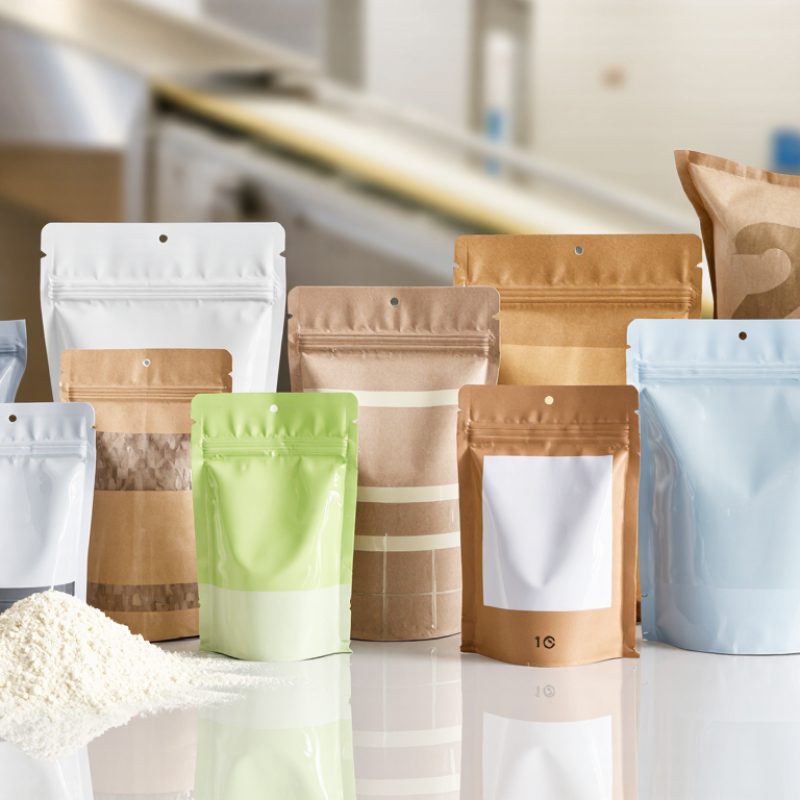
When comparing China’s top flour pouch manufacturers, global buyers should examine pouch types before reviewing price. Stand-up pouches offer shelf stability and convenient storage for retail flour. Flat pouches suit compact packing and lower-volume products. Side-gusset bags provide extra capacity for five-kilogram or larger packs. Their expanded panels also improve pallet use.

Material selection controls freshness, strength, and production efficiency. Kraft paper gives a natural appearance and supports printed branding. Plastic films provide stronger moisture resistance and dependable heat sealing. Laminated structures can combine paper, PET, and polyethylene layers for better protection. For flour, the inner layer should resist fine powder leakage. Good sealing matters more than attractive printing. A zipper improves household convenience, but it can increase cost and sometimes trap flour particles. Keep it practical.

Packaging applications vary by distribution conditions. A one-kilogram pouch may need a carry handle, clear weight marking, and a clean retail finish. Larger sacks require reinforced seals, stable stacking, and resistance to rough warehouse handling. Buyers should request seal-strength results, drop-test records, and moisture or oxygen barrier data. Food-contact documentation should also match the destination market. These checks reveal more than a factory sample. A recurring mistake is choosing thick material without testing the filling line. Excess thickness can slow production and create unnecessary waste. No pouch fits every route.

How to Evaluate Flour Pouch Manufacturers for Global Sourcing

Choosing a flour pouch manufacturer requires more than comparing unit prices. Global buyers should assess production experience, material knowledge, and documented quality controls. Ask how the factory handles flour dust, sealing pressure, and stacking during transport.

Request samples from different production batches. Inspect the gusset, zipper, printed surface, and bottom seal by hand. Material details matter. Confirm the film structure, thickness, moisture barrier, and food-contact compliance through current test reports. A pouch may look strong but weaken after weeks in humid storage.

A reliable manufacturer should explain its traceability system, inspection points, and corrective-action process. Review factory audit records, laboratory results, and export references where available. Check whether the supplier can maintain stable color, dimensions, and sealing strength at your required volume. Do not accept vague statements about “premium quality.”

Small trial orders can reveal more than impressive presentations. Test filled pouches through vibration, compression, and drop handling. Ask for clear tolerances and replacement terms before approving mass production. In practical sourcing, delays often begin with unclear artwork or unconfirmed packing details. That part is easy to overlook.

The cheapest quotation may exclude tooling, testing, or export packaging. Compare the complete landed cost. Also question capacity honestly: a factory with excellent samples may struggle during peak harvest seasons. Keep written records of every change, because memory becomes unreliable across time zones.

China Top 10 Flour Pouch Manufacturers for Global Buyers - How to Evaluate Flour Pouch Manufacturers for Global Sourcing

No. Evaluation Dimension Recommended Benchmark for Flour Pouches Documents or Tests to Request Suggested Weight Why It Matters to Global Buyers
1 Food-Contact Compliance Packaging materials should comply with the food-contact rules of the destination market, such as applicable U.S. or European requirements. Declaration of compliance, material composition, migration test reports, and ink or adhesive compliance statements. 15% Reduces customs, safety, and regulatory risks when importing food packaging.
2 Food-Safety Management A documented food-safety management system based on recognized international requirements, hazard analysis, and traceability. Valid food-safety certificate, audit report, hygiene procedures, corrective-action records, and traceability exercise. 12% Flour is a food product, so contamination control and lot traceability are essential.
3 Material Structure The film structure should match the flour’s sensitivity to moisture, oxygen, light, abrasion, and the required shelf life. Complete layer structure, thickness, resin or paper specifications, coating details, and technical data sheet. 12% Correct material selection helps prevent moisture uptake, tearing, leakage, and product spoilage.
4 Moisture and Oxygen Barrier Barrier performance should be specified by measurable water-vapor and oxygen transmission values rather than by general claims. Laboratory reports showing WVTR and OTR, including test method, temperature, humidity, and sample thickness. 12% Flour quality can deteriorate when packaging allows excessive moisture or oxygen transmission.
5 Seal Integrity Consistent heat-seal performance with suitable seal strength, clean seal areas, and no channels or pinholes. Seal-strength test, leak test, burst test where applicable, production samples, and seal-temperature window. 10% Reliable seals protect the product during filling, transport, storage, and retail handling.
6 Dimensional and Printing Quality Controlled pouch dimensions, registration, color consistency, print adhesion, and barcode readability. Approved artwork proof, color standard, dimensional inspection report, rub test, and barcode verification. 8% Stable dimensions improve filling-line efficiency and reduce rejected or unreadable packages.
7 Production Capacity and Lead Time The supplier should demonstrate sufficient converting capacity, realistic lead times, backup equipment, and raw-material planning. Capacity statement, standard production schedule, sample-to-mass-production timeline, and on-time delivery records. 10% Supports reliable replenishment and reduces supply interruptions during seasonal demand.
8 Minimum Order Quantity and Cost Transparency Pricing should clearly separate tooling, cylinders or plates, materials, printing, packing, inspection, and delivery terms. Itemized quotation, MOQ by size and structure, tooling ownership terms, payment conditions, and validity period. 8% Transparent costing improves landed-cost calculations and prevents unexpected charges.
9 Quality Control and Traceability Each production lot should be identifiable through raw materials, processing records, inspection results, and shipment documentation. Quality-control plan, certificate of analysis, retained-sample policy, lot coding, and complaint-handling procedure. 8% Makes nonconformance investigation, recalls, and corrective actions faster and more controlled.
10 Export Service and Sustainability The supplier should support export packaging, shipping documents, recycling information, and material-reduction options where technically suitable. Packing specification, export references, shipping document samples, recyclability statement, and downgauging assessment. 5% Improves logistics execution and helps buyers meet changing packaging and environmental requirements.
Total Evaluation Weight 100% Use the same evidence-based scorecard for every shortlisted supplier.

Buyer note: Certification and test requirements vary by destination market, product structure, filling process, and intended shelf life. Confirm the final specification with the importer, food-safety team, and applicable local regulations.

Top 10 Flour Pouch Manufacturers and Their Core Strengths

China’s top ten flour pouch manufacturers differ in practical strengths, not just catalogue size. Some specialise in high-speed form-fill-seal lines, while others focus on clean gravure printing, strong heat sealing, or low-dust filling. Several offer kraft-look laminates, transparent windows, and reinforced side gussets for 1–5 kilogram packs. Their strongest suppliers also provide oxygen-barrier films, batch coding, and trial production before bulk orders. These details matter beside a flour mill’s conveyor, where powder can settle inside a weak seal.

Industry data supports this attention to packaging performance. FAO’s 2022 report estimated that 13.2% of food was lost between harvest and retail in 2021. Better pouch sealing cannot solve every loss, but it can reduce leakage and moisture exposure. Smithers’ flexible packaging outlook also highlights barrier performance, lightweighting, and recyclable structures as major development priorities. The strongest manufacturers respond with material testing, seal-strength records, and documented quality checks. Still, recycled content may affect stiffness and sealing. That trade-off deserves testing.

Tips: Ask for a filled sample, not only a digital mock-up. Check seal width, drop resistance, zipper alignment, and powder residue after opening. Request migration and food-contact documents for the destination market. Compare total delivered cost, not only the unit price. A cheaper pouch can become expensive after one failed shipment. I would also question vague “eco-friendly” claims; measurable film composition and test results are more reliable.

China Top 10 Flour Pouch Manufacturers for Global Buyers

Core Strengths Buyers Commonly Compare Across Flour Pouch Suppliers

This qualitative benchmark highlights the main capabilities global buyers typically assess when comparing flour pouch manufacturers. The index reflects relative buyer relevance on a 1–10 scale rather than company-specific performance or market share.

Comparing Product Quality, Customization, Prices, and Production Capacity

China Top 10 Flour Pouch Manufacturers for Global Buyers

When comparing China’s top ten flour pouch manufacturers, product quality should come before appearance. Ask for food-contact declarations, material specifications, seal-strength reports, and recent production samples. A reliable supplier should explain film structure, moisture barriers, and storage performance clearly. Check whether pouch edges remain sealed after transport vibration and warehouse stacking. Small defects become expensive when flour leaks across a shipment.

Customization separates capable factories from simple trading companies. Review available pouch sizes, gusset shapes, zipper options, valve designs, and printing methods. Request a physical prototype before approving mass production. Color matching may look accurate on screen but differ under factory lighting. Confirm artwork control, cylinder charges, minimum order quantities, and changeover fees in writing. I have found that unclear specifications often create more delays than manufacturing itself.

Prices need careful comparison. A low quotation may exclude printing plates, packaging cartons, inspections, or inland delivery. Compare complete costs under the same trade terms and order volume. Production capacity also requires evidence, not attractive claims. Examine monthly output, equipment lists, lead times, and backup production plans. Ask how the factory handles urgent replenishment during peak harvest seasons. Capacity can appear strong until several export orders arrive together. Even experienced buyers sometimes underestimate seasonal pressure and should leave room for corrective batches.

Global Buying Steps, Compliance Checks, and Supplier Selection Tips

China Top 10 Flour Pouch Manufacturers for Global Buyers

Buying flour pouches from China requires more than comparing ten factory quotations. Start with a written specification covering pouch size, laminate structure, seal width, filling weight, artwork colors, and monthly volume. Request production samples, not only digital images. Check whether each pouch stands upright and survives a 48-hour leak test. It sounds basic. It is often missed.

Ask each manufacturer for food-contact declarations, material composition, migration-test reports, and current quality certificates. Confirm that testing covers the exact film, ink, adhesive, and pouch structure. Review factory registration, production capacity, traceability records, and pest-control procedures. For shipments, agree on Incoterms, carton counts, pallet dimensions, lead time, and inspection rights. A third-party pre-shipment inspection can verify print alignment, seal strength, odor, and quantity before payment.

Selection should balance evidence, communication, and total landed cost. A low unit price may hide high minimum orders, artwork charges, or weak export packing. Ask how defects are handled and request a corrective-action sample. I once treated smooth communication as proof of quality; that assumption was wrong. Suppliers can communicate well and still lack stable process control. Keep a comparison sheet, score every requirement, and record unanswered questions. Leave room for a pilot order. Real performance may differ from a perfect sample.

Go to Top