How to Choose a 10t Trackless Vehicle for Global Buyers?
Selecting a 10t Trackless Vehicle is a practical decision, not merely a capacity comparison. Global buyers must match payload, roadway conditions, power supply, ventilation, maintenance skills, and local safety requirements. A vehicle carrying ten tonnes may perform well underground, yet struggle on steep ramps or wet haul roads. Small details matter, including tire clearance, turning radius, braking response, and battery access.
Industry reports show why this decision is becoming more important. The International Energy Agency’s Global EV Outlook 2024 identifies continued growth in electric commercial vehicles, supported by lower operating emissions and improving battery technology. However, mining and industrial applications remain more demanding than ordinary road transport. The World Mining Data 2024 report also reflects the scale and geographic diversity of global mineral production, where equipment must operate across different climates, infrastructure levels, and maintenance environments. These findings support a careful, site-specific purchasing method.
This guide examines how to evaluate a 10t Trackless Vehicle through measurable evidence. Buyers should request verified payload tests, gradeability results, braking data, charging performance, and service records. ISO 17757 provides useful guidance for autonomous and semi-autonomous earth-moving systems, while ISO 12100 supports machinery risk assessment. Standards help. They do not replace field experience. A polished brochure can hide costly limitations, such as slow charging during shift changes or poor traction after rainfall. Even experienced teams can overlook operator training and spare-parts availability. The best choice is therefore not always the newest model. It is the safest, most maintainable vehicle for the actual worksite.
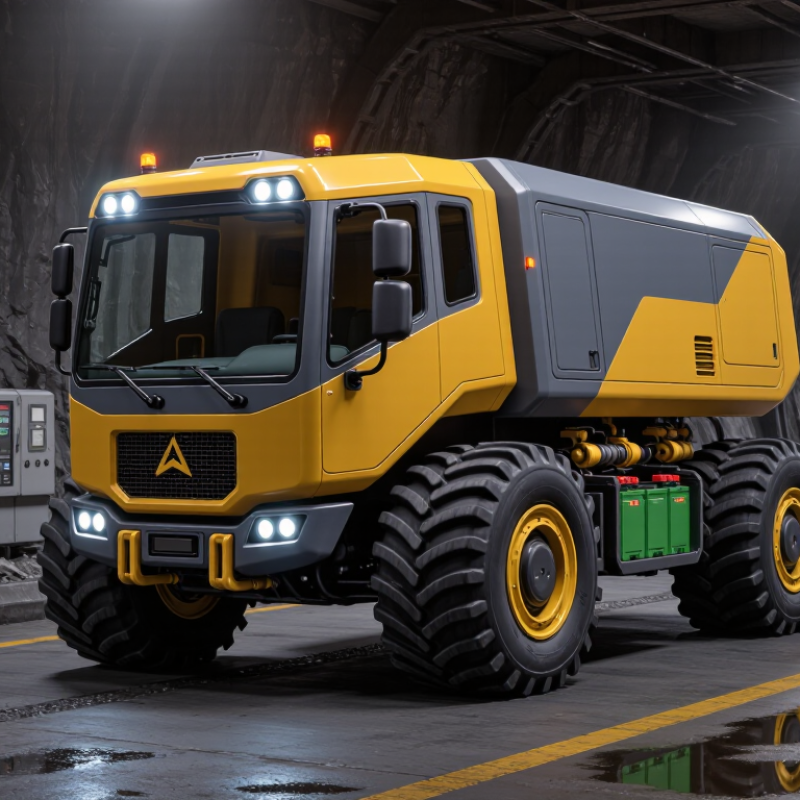
Define the Duty Profile: 10 t (10,000 kg), Load Center, and Axle Loads
A 10 t trackless vehicle should be selected from its duty profile, not its headline payload. Define 10 t as 10,000 kg of payload, then record the load center, wheelbase, floor condition, travel speed, and operating hours. A 10,000 kg steel coil positioned 1.2 m from the front axle creates a 12,000 kg·m overturning moment. With a 3 m wheelbase, the payload alone produces roughly 6,000 kg on the front axle and 4,000 kg on the rear axle. Add the vehicle’s tare weight.
Load placement changes everything. A 10 t pallet with a 600 mm center behaves very differently from a long mold with a 1,500 mm center. Use the actual center of gravity, not the drawing’s geometric center. ISO 3691-1 emphasizes stability, braking, and operating conditions for driverless industrial trucks, while EN 15512 provides useful principles for load and rack stability. These standards do not replace a project calculation. They guide it.
Public industry data also shows why careful sizing matters. The International Federation of Robotics reported 542,076 industrial robots installed globally in 2023, increasing automation around shared factory routes. That growth can expose weak assumptions. Measure axle loads dynamically, including acceleration, turning, ramps, and uneven plates. A static calculation may look safe. Reality is less polite. Clearance under the frame, tire pressure, and floor joints can alter results. Request axle-load limits from the civil engineer, and verify them with a loaded site trial before final procurement.
Match Powertrain and Battery to kWh Demand, Gradeability, and Shift Hours
Choosing a 10t trackless vehicle starts with the work cycle, not the catalog specification. Record payload, travel distance, slope length, surface condition, and idle time. A vehicle carrying steel coils on a 6% ramp needs different energy planning than one moving empty pallets. Small details matter.
Estimate daily energy in kilowatt-hours from traction, climbing, steering, auxiliary systems, and battery losses. Gradeability depends on motor torque, gear reduction, tire grip, and payload distribution. A higher peak power rating does not always deliver better hill performance. Check the continuous rating, especially during repeated climbs. Test the route with the intended load. A short demonstration run can hide thermal limits.
Shift hours shape the battery decision. For an eight-hour shift, compare usable battery capacity with measured consumption, not the advertised pack size. Keep a practical reserve for cold weather, traffic delays, and aging cells. Fast charging may support multiple shifts, but it requires suitable electrical capacity and disciplined charging procedures. In hot or dusty workplaces, cooling and enclosure protection deserve equal attention. The calculation may still be imperfect. Real routes change. Leave room for that uncertainty. A slightly smaller battery can reduce weight and charging cost, while an oversized pack may waste capacity on every trip. Review one week of operating data before approving the final powertrain.
Validate Mobility: Turning Radius, Floor Load, Speed, and Towing Limits
Choosing a 10t trackless vehicle starts with the route, not the catalog. Measure the route.
Check the minimum turning radius against your narrowest aisle and doorway. A vehicle may turn within a stated radius, yet its rear end can sweep outward. Mark the floor with chalk and test the complete path, including the load. This practical check often reveals problems that drawings miss. I have found that turning space is regularly underestimated.
Floor loading needs equal attention. Calculate wheel load, axle load, and dynamic impact, not only the average weight. A 10t payload can create dangerous pressure on joints, ramps, or older concrete floors. Ask for the loaded wheel pattern and keep a safety margin for uneven surfaces. The perfect calculation is rarely possible.
Speed is not everything. Match travel speed to visibility, pedestrians, slopes, and stopping distance. Higher speed can reduce control when carrying tall or unstable cargo. Towing limits must include trailer weight, gradient, surface resistance, and braking capacity. Confirm both continuous and short-term towing ratings. Request test data under conditions similar to your site, including heat, cold, and battery voltage changes. A cautious trial run is often more reliable than a confident specification sheet.
Audit Safety and Global Compliance: ISO 3691-4, IEC 60204-1, and CE
How to Choose a 10t Trackless Vehicle for Global Buyers?
For a 10-ton trackless vehicle, safety evidence matters more than a polished brochure. Ask for a risk assessment covering loading, steering, braking, charging, and pedestrian interaction. ISO 3691-4 is especially relevant when the vehicle operates without a driver. It addresses navigation, protective systems, speed control, and safe stopping. Test the vehicle with a full load, not an empty platform. That difference can be significant.
IEC 60204-1 helps evaluate the vehicle’s electrical equipment and control design. Inspect emergency-stop circuits, wiring labels, protective bonding, control cabinets, and restart behavior after power loss. Request test records, circuit diagrams, software descriptions, and maintenance instructions. A short demonstration is useful. It is not enough. Watch how the vehicle reacts near a person, an obstacle, and a sloped floor.
For European delivery, CE compliance should include a documented conformity assessment, technical file, risk analysis, and Declaration of Conformity. CE is not simply a sticker or a factory certificate. Confirm which EU directives and standards apply to the complete machine. For other markets, check local electrical, radio, transport, and workplace requirements separately. A supplier may meet one standard and still miss a regional obligation. That possibility deserves honest review. One audit weakness is often rushed document translation. Clear warnings and accurate manuals can prevent expensive misunderstandings. Safety should remain verifiable after installation, training, and routine maintenance.
Compare Lifecycle Value: Battery Cycles, Warranty, Spares, and TCO
How to Choose a 10t Trackless Vehicle for Global Buyers?
A 10t trackless vehicle should be judged by lifecycle value, not purchase price alone. The IEA’s Global EV Outlook 2024 reports continued growth in electric commercial transport, but operating conditions differ sharply across regions. Heat, ramps, payload, and charging habits can reduce usable battery life. Ask for tested cycle data under loaded conditions. Laboratory figures are useful, but they are not the whole story.
Battery replacement remains a major cost risk. BloombergNEF’s 2024 Battery Price Survey placed the average lithium-ion pack price at 115 US dollars per kWh. Industrial packs can cost more because they need protection, cooling, and rugged enclosures. Compare the expected cycles to 80% capacity, not only the battery’s nominal capacity. A clear warranty should state coverage, labor, transport, and acceptable capacity loss. Small wording matters.
Spares matter daily.
Request a five-year parts list, delivery targets, and local service capability. Controllers, contactors, tires, chargers, and steering components can stop work even when the battery is healthy. The U.S. Department of Energy emphasizes maintenance and energy use as important elements of vehicle operating cost. Build a TCO model using electricity, tires, labor, downtime, financing, and battery replacement. I would also test a loaded vehicle on the actual route before buying. One overlooked ramp can distort the entire calculation.