
Blog

7 Tips for Choosing PE Filler Masterbatch?

Choosing the right PE Filler Masterbatch can influence product quality, production speed, and total material cost. The wrong grade may create weak weld lines, rough surfaces, unstable feeding, or excessive die pressure. These problems often appear after production begins. Then, correction becomes expensive.

Dr. Tim A. Osswald, a respected polymer-processing authority, has said, “Polymer processing is both an art and a science.” This principle applies directly to PE Filler Masterbatch selection. Calcium carbonate content, carrier resin compatibility, particle dispersion, moisture control, and melt-flow behavior must work together. A high filler percentage may reduce resin consumption, but it can also reduce toughness or create processing difficulties. More filler is not automatically better.

Real production conditions matter. Consider a blown-film line running warm, fast, and continuously. A masterbatch that performs well in laboratory samples may disperse poorly under those conditions. Ask for technical data, but do not trust numbers blindly. Verify them through trial production, tensile testing, surface inspection, and filter-pressure monitoring. Small details matter. Even feeding consistency matters.

These seven tips will examine how to compare formulations, assess carrier compatibility, check dispersion, and judge supplier reliability. They will also address cost beyond the purchase price. That part is often overlooked. My own caution is simple: no universal formula exists. A grade suitable for shopping bags may fail in injection-molded parts. Careful testing remains essential, even when the specification appears perfect.
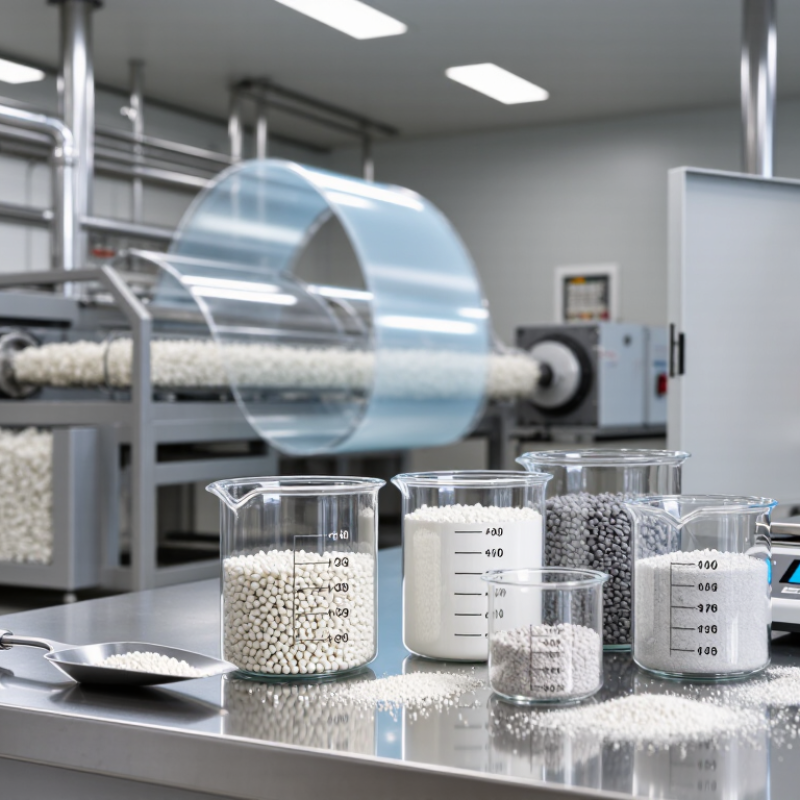
7 Tips for Choosing PE Filler Masterbatch?

Define Your PE Product Goals and Filler Masterbatch Requirements

Choosing PE filler masterbatch starts with a clear definition of your product goals. A shopping bag, pipe, and injection-molded container need different performance priorities. Decide whether you value stiffness, opacity, surface appearance, cost control, or easier processing. Do not treat filler as a universal solution.

A thin film may require stable stretching, good dispersion, and controlled melt flow. A molded part may need rigidity, dimensional stability, and a clean surface. Record the target thickness, resin grade, filler loading, processing temperature, and expected output rate. These details help suppliers recommend a suitable carrier resin and concentration. Small differences matter.

Measure the final product, not only the masterbatch. Check tensile strength, elongation, impact resistance, whiteness, haze, density, and sealing behavior when relevant. Watch the extruder closely during trials. Unstable pressure, rough surfaces, or die buildup can reveal poor compatibility or moisture. Dry storage also matters. A simple packaging failure can ruin otherwise careful testing.

Request technical data, safety information, batch consistency records, and processing guidance. Confirm that the material fits your intended application and required market standards. Run a controlled trial before changing production settings. I have seen teams increase filler loading too quickly, then blame the resin for brittle results. My own early trials were not perfect either. A lower loading sometimes gives better total value. Performance comes before the lowest purchase price.

Compare Filler Types, Polymer Compatibility, and Calcium Carbonate Quality

7 Tips for Choosing PE Filler Masterbatch

Filler selection starts with the final product. Calcium carbonate usually lowers cost and improves stiffness, while talc can provide greater rigidity but may reduce impact strength. A practical comparison should include seven checks: filler type, polymer compatibility, particle size, moisture, surface treatment, dispersion, and dosage. PlasticsEurope reported global plastics production at about 400 million tonnes in 2022. That scale makes consistent formulation control more important, not less.

Polymer compatibility deserves close attention. Choose a carrier resin matching the polyethylene grade, such as film, injection, or blow-molding material. Poor compatibility can create streaks, weak weld lines, or unstable feeding. Examine calcium carbonate particle-size data, not only the average value. A narrow distribution often supports smoother dispersion. Check moisture carefully. Even small contamination can cause bubbles during extrusion. ASTM and ISO test methods can help verify density, particle size, and moisture, but supplier certificates still need practical confirmation.

Quality is visible under a microscope and on the production line. Look for high whiteness, low iron content, controlled surface coating, and stable feeding. The U.S. Geological Survey’s Mineral Commodity Summaries consistently identifies limestone as a major industrial mineral, yet geological origin does not guarantee masterbatch quality. Trial the material at actual processing temperatures. Measure tensile strength, elongation, haze, and output stability. I once focused too heavily on price; the cheaper grade increased screen changes and waste. That lesson still needs repeating. No single filler wins every application.

7 Tips for Choosing PE Filler Masterbatch: Comparing Filler Types and Calcium Carbonate Quality

Mineral properties influence stiffness, density, abrasion, dispersion, and processing behavior in polyethylene. The values below are representative reference values; actual results vary with particle size, surface treatment, moisture, and mineral grade.

How to use this comparison: Calcium carbonate is commonly selected for PE because calcite has a Mohs hardness of about 3 and a density near 2.71 g/cm³. Talc is softer and can improve stiffness, while kaolin provides a balance of moderate density and hardness. Precipitated calcium carbonate generally offers more controlled particle morphology than ground calcium carbonate, which can support improved dispersion when the surface treatment is suitable.

Selection tips: Check polymer compatibility, choose a PE-compatible surface coating, control moisture, and verify calcium carbonate purity, particle-size distribution, whiteness, and dispersion. Higher mineral loading may reduce cost, but excessive loading or poor compatibility can increase melt torque, weaken impact performance, and cause processing defects.

Evaluate Filler Loading, Dispersion, and Processing Performance

7 Tips for Choosing PE Filler Masterbatch?

Evaluate filler loading before comparing prices. A higher loading can reduce resin use, but it may also affect toughness and surface quality. Check the actual filler percentage on the technical data sheet, not only the product name. Calcium carbonate is common, yet its particle size and surface treatment strongly influence performance. Ask for test data from a similar polyethylene grade.

Inspect dispersion under a microscope or through a trial film. Poor dispersion can create white specks, weak points, or unstable thickness. A practical test uses the intended screw, temperature profile, and dosing rate. Observe torque, melt pressure, and extrudate appearance. Keep samples from different production runs. Consistency matters.

Processing performance deserves careful attention. Compare melt flow behavior with your base PE, then check whether the blend feeds smoothly without bridging or dusting. Moisture control is essential, especially after storage in humid conditions. I have seen a seemingly good formulation fail because the bags were left open overnight. That mistake is easy to repeat. Test seal strength, impact resistance, tensile properties, and color after molding or extrusion. Do not rely on one laboratory result. A short production trial often reveals problems that a clean test sheet hides. Evaluate surface finish too. Small defects become obvious under strong warehouse lighting.

7 Tips for Choosing PE Filler Masterbatch? - Evaluate Filler Loading, Dispersion, and Processing Performance
Tip Key Evaluation Dimension Typical Data to Request Practical Screening Range Recommended Verification Why It Matters
1 Filler Loading
Confirm the mineral content stated on the technical data sheet.
Calcium carbonate content: 70–85 wt% for many high-loading PE filler masterbatch grades. Select the loading according to the target cost, stiffness, opacity, and final-product requirements. Use thermogravimetric analysis or an appropriate ash-content method. Check several samples from different production lots. Higher loading can reduce resin consumption, but excessive filler may lower elongation, impact strength, and process stability.
2 Filler Dispersion
Look for uniform distribution without visible agglomerates.
Microscopy should show a consistent particle distribution with no large clusters; a practical internal limit is often 50–100 μm for visible agglomerates. Aim for a uniform dispersion grade suitable for the film, sheet, injection-molding, or extrusion application. Prepare a thin molded or extruded section and inspect it by optical microscopy at approximately 100–200× magnification. Poor dispersion can cause streaks, weak spots, die build-up, surface defects, and unstable mechanical properties.
3 Particle Size and Distribution
Evaluate the mineral particle size and the presence of oversized particles.
Fine calcium carbonate grades commonly use a median particle size around 1.5–5 μm, depending on the application. Film applications generally require finer and more consistent particles than some thick-wall molded products. Request laser-diffraction particle-size data, including D50 and the coarse-particle fraction. ISO 13320 is commonly used for laser diffraction analysis. Smaller, well-controlled particles generally support smoother surfaces and more consistent dispersion, but may increase formulation cost.
4 Melt Flow and Processing Behavior
Match the masterbatch flow characteristics with the host PE resin.
Melt mass-flow rate may commonly fall within approximately 5–15 g/10 min, but the test temperature and load must be specified. The masterbatch should feed smoothly and should not cause excessive pressure fluctuation, torque increase, or output loss. Compare melt mass-flow rate using the same test condition for all samples, such as ASTM D1238 conditions appropriate for the selected PE grade. A major mismatch in flow can lead to poor dosing, uneven filler distribution, unstable extrusion, and inconsistent product thickness.
5 Moisture and Volatile Content
Check whether the product can be processed without drying-related defects.
A commonly requested moisture target is ≤0.20 wt%; lower limits may be preferred for thin film and high-speed extrusion. Use a tighter moisture specification when processing at high output or when surface appearance is critical. Test moisture by a calibrated moisture analyzer or an appropriate loss-on-drying method. Store samples in sealed packaging before testing. Excess moisture may contribute to bubbles, pinholes, silver streaks, surface roughness, and inconsistent extrusion pressure.
6 Carrier Resin Compatibility
Ensure the carrier is compatible with the host PE and the production process.
Identify whether the carrier is LDPE, LLDPE, HDPE, or another compatible polyolefin, and confirm the recommended let-down ratio. A starting trial level of 10–30% masterbatch is common, but the final dosage depends on the required filler level and product performance. Run a controlled trial at the intended dosage and compare torque, melt pressure, surface appearance, tensile properties, and seal performance where applicable. Good carrier compatibility improves feeding, mixing, mechanical performance, and the consistency of the final PE compound.
7 Thermal Stability and End-Use Performance
Evaluate performance under the actual processing and application conditions.
Typical PE processing zones may operate around 170–220°C, depending on resin type, equipment, residence time, and product design. The masterbatch should process without abnormal odor, discoloration, gas formation, severe die build-up, or unacceptable property loss. Conduct a pilot trial using representative barrel temperatures, screw speed, residence time, and cooling conditions. Test tensile strength, elongation, impact, opacity, or stiffness as required. Laboratory data alone may not reveal process-specific defects; production-like trials confirm whether the masterbatch meets real operating requirements.
Note: The numerical ranges are practical screening references rather than universal specifications. Final acceptance criteria should be adjusted for the PE grade, filler type, target dosage, equipment, product thickness, and end-use requirements.

Check Supplier Reliability, Quality Control, and Technical Support

7 Tips for Choosing PE Filler Masterbatch

Tip: Check supplier reliability before discussing price. PlasticsEurope reported 400.3 million tonnes of global plastics production in 2022. This scale makes stable supply essential. Ask for production capacity, lead times, backup raw-material sources, and recent delivery records. A useful supplier should share batch traceability, not vague promises. I have learned that a polished certificate is not enough.

Tip: Examine quality control closely. Request test data for calcium carbonate content, moisture, melt flow rate, particle dispersion, and carrier compatibility. Compare samples under your actual extrusion conditions. ISO’s 2022 Survey recorded over 1.26 million valid ISO 9001 certificates worldwide, but certification alone does not prove filler consistency. Request a certificate of analysis for every batch. Check retained samples when possible. No audit is perfect.

Tip: Test technical support before signing a contract. Ask whether engineers can adjust loading levels, screw speed, temperature, and cooling conditions. Reliable advice should address surface defects, reduced impact strength, unstable feeding, or die buildup. A supplier that only sends a datasheet may not support production problems. During trials, record barrel temperatures and output changes. Small details matter.

Tip: Verify documentation and communication speed. Review safety data, regulatory statements, packaging specifications, and complaint procedures. Ask for a written corrective-action report after a failed batch. I would also run a small pilot order. It costs more time, but it exposes weak support early. One overlooked variable can distort the entire evaluation.

Confirm Cost Efficiency Through Testing, Compliance, and Trial Production

7 Tips for Choosing PE Filler Masterbatch

Cost efficiency starts with testing, not the quoted price. Request a representative sample and record its loading ratio, dispersion, moisture, melt flow, and color stability. Test it in your actual PE grade and processing conditions. A small laboratory trial can reveal surface streaks, die buildup, or weak film strength. These defects become expensive during continuous production.

Compare cost per finished product, not cost per kilogram of masterbatch. Measure output, energy use, scrap rate, and replacement frequency. Check whether the filler allows stable production at the planned dosage. Ask for technical data, safety documents, batch consistency records, and compliance information for your target market. Do not rely on an old certificate. Requirements and formulations can change. The supplier should explain test methods clearly and provide traceable results.

Trial production is essential. Run enough material to observe feeding, mixing, cooling, cutting, and final performance. Inspect bags, sheets, pipes, or molded parts after storage and handling. A short trial may look successful, yet longer production can expose uneven dispersion. That assumption can be wrong. Keep a control sample and compare tensile strength, stiffness, appearance, and dimensional stability. Record every setting, including screw speed and temperature. If the masterbatch saves material but increases rejects, it is not truly economical. Recheck the calculation after the trial, because real production often differs from laboratory expectations.

Go to Top