
How to Find a Professional Board Games Manufacturer in 2026?
Finding a Professional Board Games Manufacturer in 2026 requires more than comparing attractive factory websites. A reliable partner should demonstrate real production experience, clear quality procedures, and consistent communication. Their portfolio should show different game formats, including card games, strategy boards, miniatures, and custom packaging. Ask for physical samples, not only polished digital images. A sample can reveal cardboard thickness, color accuracy, edge finishing, print alignment, and component durability.
Experienced buyers should examine how each manufacturer manages prototypes, revisions, inspections, and delivery schedules. Request a detailed quotation that separates tooling, printing, assembly, packaging, shipping, and possible setup fees. Visit the facility when practical, or arrange a live video inspection of the production line. Review certifications, material sources, safety testing, and export experience for your target markets. Reliable manufacturers explain limitations early. They do not promise impossible prices or timelines.
No checklist is perfect. A factory may produce excellent samples yet struggle during large-volume production. That assumption can fail. Therefore, confirm quality controls through a pilot order and written acceptance standards. Discuss file formats, color references, approved samples, defect tolerances, and replacement policies before production begins. Communication matters just as much as machinery. Delayed answers can become delayed launches.
The right partner should understand your audience, budget, artwork, and retail expectations. They should also offer practical suggestions without taking control of your product vision. In 2026, responsible sourcing and transparent production records will influence many purchasing decisions. Careful research reduces costly surprises. It also creates a stronger foundation for long-term cooperation. Reliability is earned slowly.
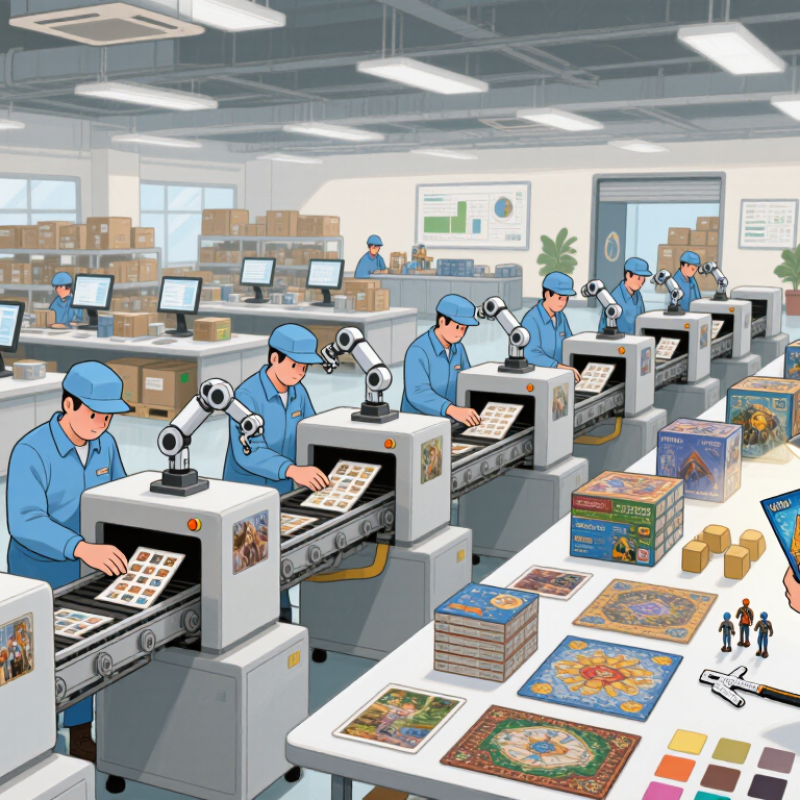
Define Your Board Game Manufacturing Requirements
Before contacting a board game manufacturer, turn your idea into measurable requirements. Record the finished box dimensions, player count, age range, and expected production quantity. List every component: cards, boards, dice, tokens, inserts, and rulebooks. Specify materials where they affect play, such as card thickness or a board’s folding style. A vague request for “premium quality” is hard to quote consistently. A sample card with a chosen finish is more useful.
Tips: Build a component checklist. Add reference photos. Mark which details are essential and which can change. Ask how prototypes and revisions are priced.
Then define your quality checks and practical limits. Decide what you will inspect, from color consistency to whether pieces fit neatly inside the box. Set a target unit cost, but include packaging, sample fees, and freight in your estimate. Share your preferred delivery window and ask the manufacturer which production milestones they can confirm. Leave room for revisions; artwork may look different in print than on a screen. You may not know every specification yet. Note open questions honestly, and ask for recommendations with clear trade-offs, not just the lowest quote.
How to Find a Professional Board Games Manufacturer in 2026? - Define Your Board Game Manufacturing Requirements
| Requirement Dimension | Recommended Definition | Practical Planning Data | Information to Request from a Manufacturer | Why It Matters |
|---|---|---|---|---|
| Game Format | Identify whether the product is a card game, tabletop game, strategy game, party game, educational game, or campaign-based game. | Define the target age, estimated play time, player count, and complexity level before requesting quotations. | Ask for previous experience with products using similar component types, packaging, and assembly methods. | The game format determines tooling, assembly, testing, packaging, and quality-control requirements. |
| Component List | Create a complete bill of materials covering every card, board, tile, token, dice, miniature, insert, rulebook, and package element. | Record the exact quantity per box, component dimensions, material, finish, and tolerance for each item. | Request confirmation that the quotation includes all components, assembly steps, accessories, and replacement parts. | A precise bill of materials reduces quotation gaps, production disputes, and unexpected charges. |
| Materials and Sustainability | Specify paperboard grade, paper weight, plastic type, wood type, coatings, adhesives, and recycled-content targets. | Common specifications include laminated paperboard for boards and cards, molded pulp or paper inserts, and water-based or low-odor coatings. | Ask for material technical sheets, recycled-content documentation, and available certification evidence where required. | Material choices influence durability, safety, appearance, recyclability, weight, and total cost. |
| Print and Finish | Define color process, print sides, surface coating, foil, embossing, spot effects, edge treatment, and color tolerances. | Specify artwork using a professional print-ready file with bleed, trim lines, safe areas, and clearly defined color references. | Request a pre-production proof, color approval process, inspection standard, and procedure for handling print variation. | Print and finish decisions directly affect visual consistency and perceived product quality. |
| Dimensions and Weight | Define the assembled size, packed size, product weight, carton dimensions, and maximum acceptable variation. | Use metric measurements and include tolerances for cut size, board thickness, box fit, and component alignment. | Ask for a physical or digital packaging mock-up and estimated master-carton dimensions and gross weight. | Size and weight affect storage, shipping cost, shelf presentation, and packaging strength. |
| Production Quantity | Separate prototype quantity, pilot quantity, first production run, and forecasted annual volume. | Prepare at least three scenarios: development sample, small commercial run, and scaled production volume. | Request minimum order quantity, quantity-based pricing, setup fees, overrun policy, and capacity planning information. | Order volume changes unit pricing, setup-cost allocation, inventory risk, and production priority. |
| Prototype and Approval | Define the number of prototype rounds, required sample fidelity, approval authority, and revision process. | Plan for structural samples, printed proofs, component checks, and a final pre-production sample before mass production. | Ask whether sample fees are refundable, how revisions are priced, and which approved sample controls production. | A documented approval process prevents unauthorized changes after production begins. |
| Quality Standards | Set measurable standards for color, cutting, registration, surface defects, component counts, box fit, and assembly accuracy. | Use a written quality checklist and define critical, major, and minor defects before production. | Request the inspection method, sampling plan, inspection report format, corrective-action process, and responsibility for rejected goods. | Measurable acceptance criteria make quality discussions objective and enforceable. |
| Safety and Compliance | Identify destination markets, intended age group, small-part risks, chemical restrictions, labeling, and required documentation. | Compliance requirements vary by destination and age classification; define the applicable market rules before finalizing materials. | Ask for test reports from qualified laboratories, material declarations, traceability records, and support for required warning labels. | Compliance planning reduces legal, customs, recall, and market-access risks. |
| Packaging and Assembly | Define box structure, insert design, component bagging, sealing method, barcode placement, and carton configuration. | Specify whether components are sorted manually or automatically and whether each box requires a packing checklist. | Request packaging drawings, packing photos, drop-test options, carton markings, and confirmation of component-count controls. | Correct packaging protects the product and reduces missing-part, damage, and fulfillment problems. |
| Schedule and Capacity | Set target dates for artwork release, sampling, approval, production, inspection, and shipment. | Include additional time for revisions, material procurement, testing, holidays, freight, and customs clearance. | Ask for a milestone schedule, production lead-time assumptions, capacity during peak periods, and delay-notification procedures. | A realistic schedule helps coordinate launches, crowdfunding fulfillment, retail delivery, and inventory planning. |
| Cost Structure | Separate unit price, tooling, sampling, testing, packaging, inspection, freight, duties, and payment-related costs. | Compare quotations using the same specifications, quantity, delivery term, currency, and tax assumptions. | Request a line-item quotation with validity period, payment schedule, tooling ownership, and charges for artwork or engineering changes. | A transparent cost structure makes suppliers comparable and prevents hidden manufacturing expenses. |
| Logistics and After-Sales Support | Define shipping destination, delivery term, replacement-part policy, spare-unit allowance, and claims procedure. | Prepare carton count, pallet requirements, delivery window, customs documents, and destination warehouse instructions. | Ask how shortages, transit damage, defective units, rework, replacements, and post-production changes are handled. | Clear logistics and support terms protect delivery continuity and reduce the impact of quality or transit issues. |
Planning note: All quantities, tolerances, testing, labeling, and documentation should be confirmed against the destination market, product age classification, final materials, and agreed contract terms.