Choosing a reliable wire harness production supplier affects product safety, delivery stability, and long-term manufacturing costs. A polished website proves very little. The real evidence appears in sample quality, process control, documentation, and communication.
A capable supplier should understand wire selection, terminal compatibility, crimping standards, routing, labeling, and testing requirements. Ask for production samples, inspection records, and clear explanations of corrective actions. Examine crimp consistency closely. Loose terminals, uneven insulation stripping, or unclear labels can create expensive failures later. Small details matter.
Experience should be visible.
Review the supplier’s equipment, trained personnel, and quality system. Confirm whether they can manage your required volumes without sacrificing repeatability. Their facility should support continuity testing, pull-force verification, visual inspection, and traceable batch records. Industry certifications may strengthen confidence, but they should not replace practical verification.
Communication deserves careful attention. Can the supplier identify risks before production begins? Do engineers respond with measurable solutions? Are changes recorded and approved? These questions often reveal more than a sales presentation.
Cost remains important, but the lowest quotation may hide weak controls, unstable materials, or delayed deliveries. A better decision compares total value, including defect risk, logistics, tooling, and after-sales support. It is also wise to begin with a controlled trial order. No supplier is perfect. Even experienced teams can overlook a connector revision or an unclear drawing. A thoughtful evaluation process helps expose those gaps early and builds a more dependable manufacturing partnership.
When choosing a wire harness production supplier, define acceptance criteria before requesting quotations. IPC/WHMA-A-620 provides practical requirements for cable and harness workmanship, including terminals, crimps, solder joints, insulation, and labeling. It helps both sides speak the same technical language.
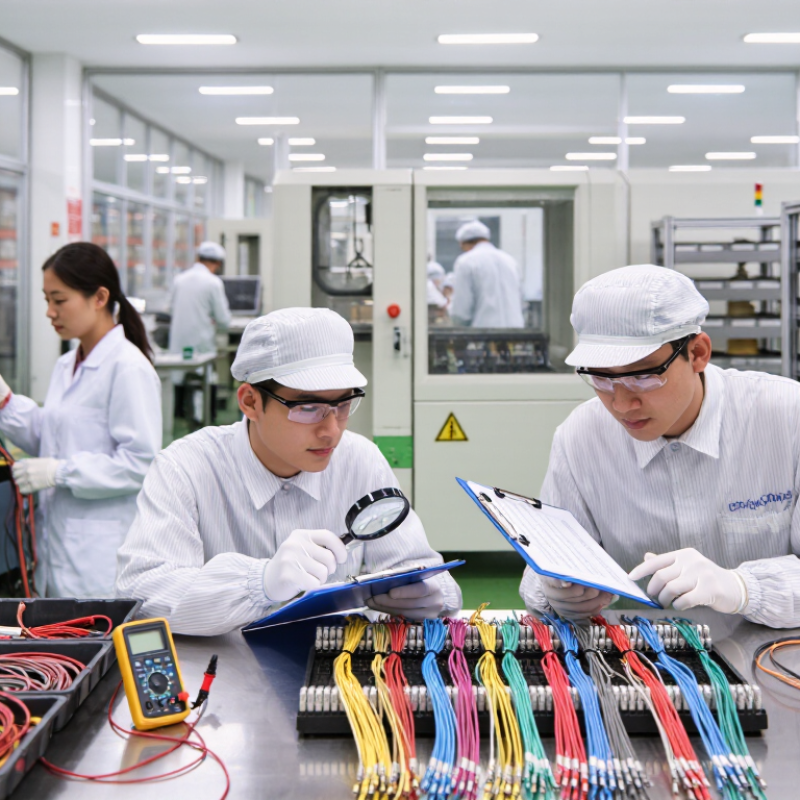
A reliable supplier should review your drawings against the applicable revision of IPC/WHMA-A-620. The supplier must also identify other relevant standards, customer specifications, and product safety requirements. Ask how operators are trained and how workmanship is inspected. Useful evidence includes crimp-height records, pull-force tests, continuity checks, insulation resistance tests, and sample inspection reports. For critical assemblies, request cross-section analysis of selected crimps. Small details matter. A loose terminal can create heat, noise, or an intermittent failure inside finished equipment.
Traceability is equally important. Each production lot should connect to wire, terminals, tooling, inspection results, and operator records. Confirm that the supplier controls tooling calibration and handles engineering changes without confusion. In practice, drawings are sometimes incomplete. That is where an experienced supplier should ask precise questions instead of guessing. A perfect checklist is not enough. I would also inspect a pilot build, because a clean sample may hide process weaknesses. Review actual cut lengths, branch routing, bend protection, and label placement under normal assembly conditions. Some requirements may still need refinement after testing. That is not a failure; ignoring the gap is. Reliable production begins when standards, drawings, testing, and communication support each other.
Choosing a wire harness production supplier requires more than comparing unit prices. Start with IATF 16949 certification. It shows that the supplier follows automotive quality methods, including traceability, process control, risk analysis, and corrective action. Ask for the certificate scope, issuing body, expiry date, and manufacturing site. A certificate is useful evidence, but it does not guarantee perfect production.
ISO 9001 adds a broader quality-management framework. The ISO Survey 2023 recorded more than 1.2 million valid ISO 9001 certificates worldwide. This scale shows its importance, yet certificate counts cannot reveal crimp height, pull-force testing, or terminal insertion quality. Request recent capability studies, inspection records, and sample harnesses. Look for labeled wires, controlled bend radii, sealed connectors, and clear lot identification. Small details matter.
Environmental control also deserves attention. The same ISO Survey reported over 600,000 ISO 14001 certificates globally. A certified supplier should manage material use, waste, chemical handling, and environmental objectives. For wire harnesses, verify UL certification or recognition for the applicable wire, insulation, and assembly requirements. Check whether the approval covers your exact construction, not merely a similar product. Review audit findings, training records, and change-control procedures. I would also inspect one ordinary production shift, not only the prepared showroom line. That step is often missed. Supplier selection remains partly judgment, and certification evidence should be tested against actual factory behavior.
How to Choose a Wire Harness Production Supplier?
Supplier capacity must match your real demand, not an optimistic forecast. Request monthly output by harness type, current utilization, overtime levels, and available expansion space. A supplier producing 100,000 assemblies monthly may struggle with your 30,000-unit order if its lines already run at 95% capacity. The 2024 Deloitte Smart Manufacturing Survey found that 86% of manufacturing leaders view smart manufacturing as important for competitiveness within three years. Yet automation alone cannot solve overloaded planning.
Examine the equipment behind the claimed capacity. Ask about automatic cut-and-strip machines, crimp-force monitoring, pull-test systems, continuity testers, and vision inspection. The equipment should fit your wire sizes, terminals, seals, and quality limits. IPC industry research continues to identify labor availability and supply-chain instability as major electronics manufacturing concerns. This makes process monitoring valuable, especially when experienced operators are scarce. Still, excessive automation may reduce flexibility for low-volume, high-mix harnesses.
Lead time should be tested against demand swings. Request typical, best-case, and recovery lead times, including material procurement and approval stages. A 2023 McKinsey supply-chain survey found that many companies had redesigned networks after repeated disruptions. That lesson applies here: confirm alternate material sources and documented escalation procedures. I would also review three recent delivery records, not only a polished capability presentation. Capacity figures can look impressive. Real performance is usually less perfect.
How to Choose a Wire Harness Production Supplier?
A supplier audit should begin with measured evidence, not polished presentations. Review monthly PPM, first-pass yield, and Cpk by product family. Ask for twelve months of records. One month proves little.
PPM shows customer escapes. First-pass yield shows how often harnesses pass without rework. Check the line: terminal insertion, crimp height, pull-force testing, continuity, and label verification. The IPC/WHMA-A-620 standard defines workmanship expectations, but your purchase agreement should add measurable limits. Numbers need context. A supplier reporting 300 PPM may hide rework, sorting, or unrecorded returns.
Cpk reveals process capability against specification limits. NIST/SEMATECH statistical guidance supports using capability indices with stable, approximately normal processes. At Cpk 1.33, a centered process represents roughly 66 defects per million opportunities beyond two specification limits, under short-term assumptions. That assumption matters. A drifting crimp machine can destroy the calculation. Require control charts, gauge studies, and documented reaction plans. The AIAG Statistical Process Control reference also emphasizes process stability before capability evaluation.
Do not accept Cpk alone. Compare it with first-pass yield and field-return PPM. A supplier may show strong capability on a wide drawing tolerance, yet fail on actual connector fit. Audit traceability down to operator, applicator, lot, and test station. I would still challenge perfect dashboards. One warning. Data can be clean while the process is not.
Anonymized production-audit comparison based on commonly used automotive and industrial quality-control thresholds.
| Audit Record | Product Scope | Audit Period | Units Inspected | Defective Units | Defect Rate (PPM) | First-Pass Yield | Critical Characteristic Cpk | Traceability & Process Control | Audit Decision |
|---|---|---|---|---|---|---|---|---|---|
| Production Audit 01 | Low-voltage signal harnesses | Q1 2026 | 120,000 | 9 | 75 PPM | 99.1% | 1.67 | 100% barcode traceability; automated continuity test | Approved |
| Production Audit 02 | Power distribution harnesses | Q1 2026 | 98,500 | 11 | 112 PPM | 98.8% | 1.52 | Lot-level traceability; crimp-height SPC monitoring | Approved |
| Production Audit 03 | Shielded data and communication harnesses | Q1 2026 | 86,400 | 14 | 162 PPM | 97.9% | 1.41 | Operator scan verification; shielding resistance test recorded | Conditional Approval |
| Production Audit 04 | High-temperature engine-compartment harnesses | Q1 2026 | 74,000 | 19 | 257 PPM | 96.8% | 1.29 | Manual final inspection; incomplete reaction-plan records | Corrective Action Required |
| Production Audit 05 | Compact sensor and actuator harnesses | Q1 2026 | 132,000 | 7 | 53 PPM | 99.4% | 1.86 | Full unit genealogy; automated electrical and vision inspection | Approved |
Supplier evaluation should begin with traceability, not price.
Each harness should link to material lots, operator records, crimp-force results, and inspection images. A practical audit follows one finished assembly backward to terminals, wire reels, tooling, and approved work instructions. This exposes gaps quickly.
APQP controls should include design reviews, process flow, PFMEA, control plans, capability studies, and documented change approval. The AIAG APQP framework remains a useful reference for this evidence-based approach.
Cost models deserve equal scrutiny.
Ask suppliers to separate material, labor, tooling, testing, packaging, logistics, and engineering changes. A low piece price can hide weak process capability or frequent rework.
McKinsey’s 2023 Global Supply Chain Leader Survey reported that 73% of companies had changed suppliers, showing how unstable sourcing assumptions can become.
I would request a costed scenario for copper volatility, overtime, expedited freight, and forecast changes. Not every spreadsheet reflects reality.
Supply continuity requires more than a second supplier on paper.
Review capacity by machine, trained operators, critical components, maintenance coverage, and recovery time after disruption. Request recent delivery performance and evidence from a real escalation.
The 2023 McKinsey survey also found that 60% of companies increased inventory buffers, but inventory alone cannot repair poor visibility.
A supplier may pass the audit and still fail under pressure. That possibility should remain visible.
Schedule quarterly reviews, test traceability samples, and challenge assumptions before production begins.
Phone: (256) 845-1255 or (256) 845-4493
Fax: (256) 845-1321 or (256) 845-4468
© 2025 Heritage Wire Harness, LLC