A garden can look bright at noon and still leave lettuce scorched by late afternoon. Choosing Garden Sun Screen Netting is not simply a matter of buying the darkest fabric. Shade percentage, mesh, color, crop, and local weather all affect the result. The right choice softens harsh sunlight while leaving enough light and airflow for healthy growth.
The scale matters. USDA National Agricultural Statistics Service data from the 2022 Census of Agriculture put U.S. horticulture specialty-crop sales at $18.3 billion, a reminder that growing conditions carry real value. For practical selection, University of Florida IFAS Extension guidance on greenhouse shade emphasizes matching shade to crop needs. Dr. Paul Fisher, a University of Florida greenhouse specialist, offers a useful principle, paraphrased here: “Choose shade for the crop’s light needs, not the fabric’s color alone.” Check the netting’s stated shade rating, then consider how it will perform over your actual beds.
Look closely at the site. A tomato bed in a hot, exposed yard may need a different treatment from seedlings under a sheltered frame. Feel the midday heat. Watch where shadows fall. Small details count.
And be honest about uncertainty. A label cannot predict every garden, and a shade level that helps in July may feel excessive in a cloudy spring. This guide explains how to compare netting, avoid common sizing mistakes, and choose a practical option for your plants and climate.
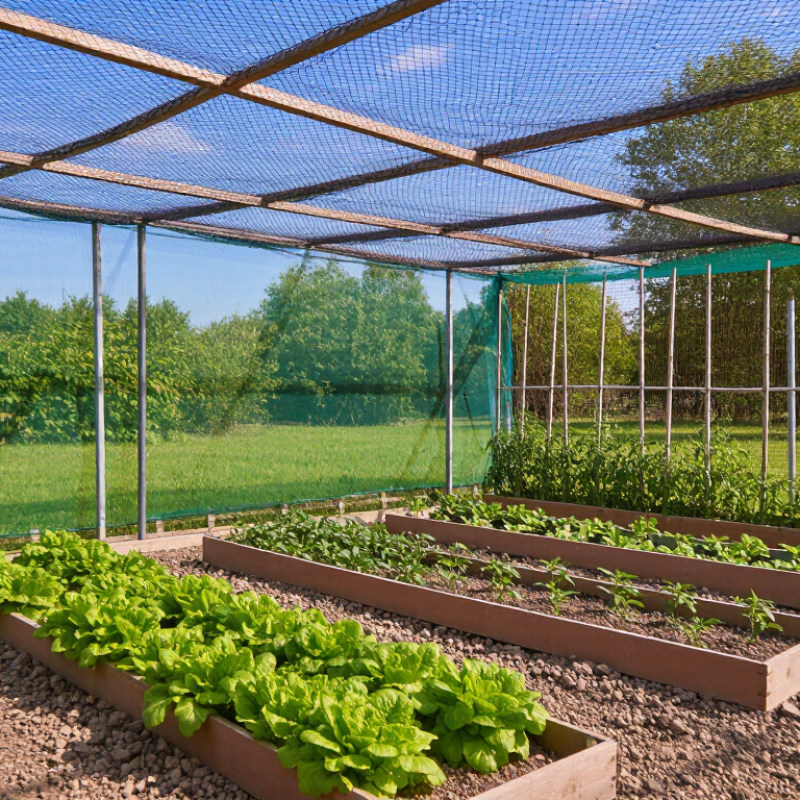
Before choosing a net, track direct sunlight at plant level for several clear days. Note morning and afternoon exposure separately; a fence or tree can shift the shade line by lunchtime. University of Minnesota Extension uses six or more hours of direct sun as a useful full-sun benchmark for many vegetables. Less light may call for a lighter net, not automatically a darker one. Check the crop’s needs, too. Lettuce may welcome afternoon shade, while fruiting plants often need stronger light. Small differences matter.
Then identify what needs protection: tender leaves, newly transplanted seedlings, or people working nearby. Shade-cloth ratings indicate the proportion of sunlight blocked, so a 40% net blocks more light than a 30% net. Clemson Cooperative Extension describes shade cloth in these percentage grades; treat them as a starting point, not a promise of a specific garden temperature. The EPA advises sun protection when the UV Index reaches 3 or higher, a useful cue for planning midday work. Try a modest shade level first and observe leaf color, flowering, and soil drying for a week. I’ve found that one sunny afternoon can mislead; cloud cover and seasonal sun angles complicate the picture. A simple notebook helps.
Identify how much sunlight your garden receives and how much protection your plants need. A net’s shade rating is the approximate percentage of sunlight it blocks; the remaining percentage passes through.
Use the ratings as a starting point, and consider your plants’ light requirements and local heat when choosing netting.
Shade ratings describe the portion of sunlight a net blocks, not the amount every plant needs. A 30% shade net nominally blocks 30% and transmits about 70%; actual light varies with sun angle, cloud cover, and net condition. Start with the crop. University of Minnesota Extension guidance says most fruiting vegetables need at least six hours of direct sun daily, while leafy crops generally tolerate more shade. That is a useful starting point, not a universal rule.
Match the rating to your garden’s measured light. If tomatoes already receive six hours of direct sun, heavy shade may reduce flowering and fruiting. In a hot bed of lettuce, moderate shade can soften harsh afternoon sun and slow bolting. Check light at leaf height, ideally with a PAR meter, and compare readings before and after installing netting.
A shade percentage alone cannot predict daily light because morning and afternoon sunlight differ. Even this math has limits. I would begin with a removable, lighter net, then observe leaf color, growth, and soil drying for a week.
Extension recommendations describe crop needs, but local heat, season, and reflected light can change the result. University of Minnesota Extension, “Growing Vegetables in Shade.”
Choose netting by material, UV treatment, and construction—not by color alone. Knitted polyethylene is light, flexible, and easy to cut, while woven options often hold their shape better under tension. Check the product label for stated shade percentage and UV stabilization; these describe different things. Shade percentage measures light reduction, not how long the net will last. NOAA classifies a UV Index of 6–7 as high and 8–10 as very high, so exposed gardens can face substantial seasonal stress. A pale net may still block useful light, but only its stated rating or a transmission test can confirm how much.
Ask for evidence of weathering tests, not just a “UV-resistant” claim. ASTM G154 provides a controlled method for exposing materials to fluorescent UV and moisture cycles; test results help compare samples, but do not translate neatly into years outdoors. Inspect stitching, edge reinforcement, and grommets, too. Those often fail before the mesh does. In practice, rubbing a sample between your fingers and checking for brittle strands can reveal weaknesses, though it is not a laboratory test. I would also leave room for doubt: wind, dust, installation tension, and local sun exposure all change service life. A well-rated net can still tear at a poorly secured corner.
Choosing mesh size starts with the plants and the strength of your afternoon sun. Fine mesh can provide denser shade, while more open mesh allows greater airflow and brighter light. Check the product’s stated shade rating, then compare it with the needs of your crops; leafy greens and fruiting plants may not benefit from the same level. A small test area helps. Watch for pale leaves, wilting, or slow growth over several days, and adjust if needed. Shade ratings are useful, but they do not tell the whole story.
Color also affects how the space feels. Black netting often gives even shade, green can blend into a garden, and lighter colors may soften direct light. Results vary with the weave and sunlight, so avoid choosing by color alone. Measure the full area, including extra fabric for overlaps and secure edges. Leave room for airflow, and support the net above plants rather than letting it rest on delicate leaves. Measure twice. I have found that a neat first estimate can still come up short once posts and tie-downs are added. A little extra width is usually easier to manage than a taut, undersized sheet.
| Garden Need | Suggested Shade Level | Mesh and Airflow | Color to Consider | Example Dimensions | Selection Tip |
|---|---|---|---|---|---|
| Vegetable beds in strong summer sun | 30–40% | Open-knit mesh for good airflow | White or light-colored netting can reduce radiant heat while admitting light | 6 × 10 ft (1.8 × 3.0 m) for a small bed; 10 × 20 ft (3.0 × 6.1 m) for a larger area | Start with moderate shade; excessive shade can reduce growth in sun-loving crops. |
| Leafy greens and other crops prone to heat stress | 40–50% | Medium-open mesh; retain airflow to limit heat buildup | White for a brighter, cooler environment; green for a less noticeable garden covering | 10 × 10 ft (3.0 × 3.0 m) over a compact bed; 12 × 20 ft (3.7 × 6.1 m) for several rows | Use the higher end of the range in very hot, exposed locations and monitor plant response. |
| Shade-tolerant plants and nursery areas | 50–60% | Medium mesh with enough openness for ventilation | Black provides strong, neutral shade; green blends into planted surroundings | 10 × 20 ft (3.0 × 6.1 m) for a small nursery zone; 20 × 20 ft (6.1 × 6.1 m) for a broader area | Check the light needs of each plant; shade percentages are nominal and can vary by product. |
| Patio, greenhouse, or outdoor work area | 50–70% | Choose a breathable knit; avoid blocking ventilation openings | Black offers substantial sun reduction; white can help keep the covered space brighter | 10 × 10 ft (3.0 × 3.0 m) for a small seating area; 20 × 30 ft (6.1 × 9.1 m) for a larger span | For overhead use, allow for secure anchoring and wind load; do not attach loosely. |
| Windy or exposed garden sites | 30–50%, depending on crop and climate | More open mesh generally allows more air through than denser netting | Choose based on shade needs; color does not replace proper installation | Measure the frame first; allow extra material for fastening and edge overlap | Use reinforced edges and evenly spaced supports. Remove or secure the netting during severe weather. |
| Before ordering: Measure the area to be covered, including allowance for attachment points and overlap. Shade percentages describe approximate light reduction and may differ between manufacturers; compare product specifications and match the shade level to the plants and local conditions. | |||||
A garden’s shape should determine how its sun screen is supported. For a narrow raised bed, a simple hoop frame lets you pull netting taut and lift it for weeding. For a long row, overhead wires or a ridge line can support one continuous panel. University of Georgia Cooperative Extension guidance describes shade cloth by the percentage of sunlight it blocks, with common ratings including 30%, 50%, and 70%. Match the rating to the crop’s light needs, not just the hottest afternoon. Small beds differ.
For a patio garden, attach a small panel to a freestanding frame rather than tying it to a weak fence. In windy, exposed plots, use closely spaced supports and secure edges with clips or rope; broad, loose panels can flap and tear. Leave access along one side for watering and harvesting. A sloped span can shed rain better than a flat one, though it may shade unevenly. Measure the bed at ground level and again above the plants, where stems widen. A tidy drawing can still mislead. Check the net’s reach and support points in place before cutting, because my first measurements would not always account for awkward corners.
Phone: (256) 845-1255 or (256) 845-4493
Fax: (256) 845-1321 or (256) 845-4468
© 2025 Heritage Wire Harness, LLC