
Blog

What Is a Super Intalox Saddle and How Does It Work?

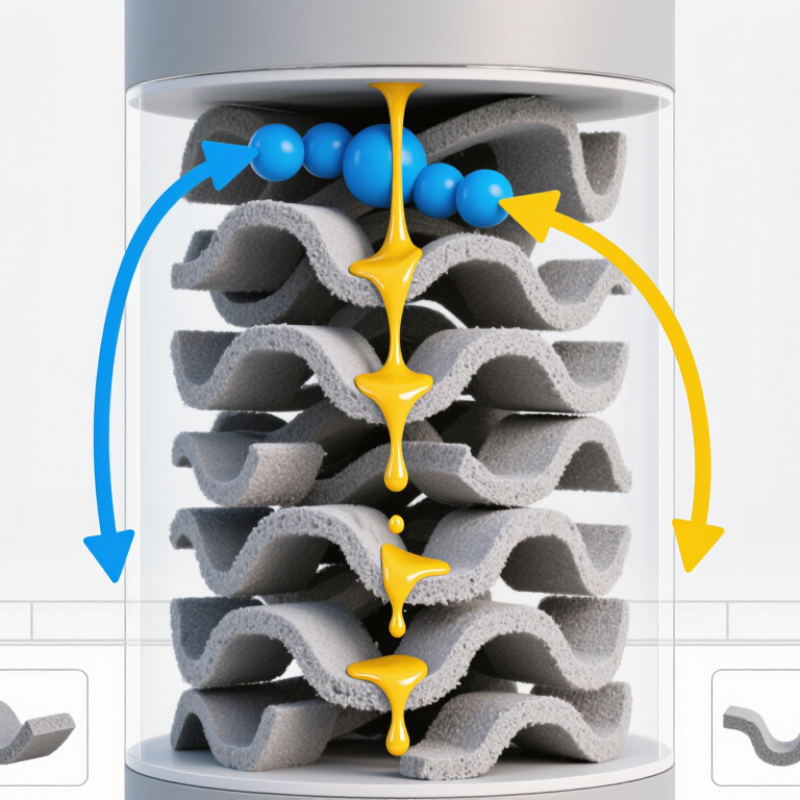
Packed towers are used to bring gas and liquid into close contact during absorption, stripping, and scrubbing. Inside, the packing creates a wetted surface while leaving open paths for gas flow. The Super Intalox Saddle is a random packing shaped to support that contact. Its curved, open geometry helps distribute liquid and limit resistance to rising gas. Small details matter: liquid should spread across the pieces, not run through one narrow channel.

Koch-Glitsch’s technical literature describes Super Intalox Saddle as a high-performance tower packing. For broader context, the U.S. EPA’s Air Pollution Control Cost Manual discusses packed-bed scrubbers and the role of packing in gas-treatment equipment. The GPSA Engineering Data Book also provides established guidance on packed-tower design and operation. These sources help frame the engineering principles, but they do not guarantee a specific result for every tower.

Performance depends on more than packing shape. Gas and liquid rates, fluid properties, tower diameter, bed depth, and liquid distribution all affect capacity and pressure drop. Poor distribution can leave parts of the bed underused. That matters. This is why engineers check operating conditions and compare pressure-drop and mass-transfer requirements before selecting a packing. Supplier data are useful, but they are not a substitute for process-specific design. A closer look at how the Super Intalox Saddle works reveals both its practical advantages and its limits.
What Is a Super Intalox Saddle and How Does It Work?

What a Super Intalox Saddle Is

A Super Intalox saddle is a piece of random packing used inside a packed tower. Its curved, open shape creates surfaces where liquid can spread while vapor moves through the bed. Unlike a simple ring, the saddle has a contoured profile that helps reduce close stacking and leaves pathways for flow. The exact shape and performance vary by material and size.

In operation, liquid trickles over the packing and forms thin films on its surfaces. Rising vapor contacts those films, allowing heat or components to transfer between the two phases. It is not a filter, and it does not work alone: tower design, liquid distribution, and operating conditions all matter. A poorly distributed feed can leave parts of the bed nearly dry.

Tips: Check the material’s chemical and temperature compatibility before choosing a packing. Also inspect how evenly liquid reaches the bed. Small gaps or dry patches can affect performance. Even a well-designed saddle cannot fix every installation issue. Some field results are less tidy than the diagrams suggest.

How Its Shape Supports Liquid and Gas Flow

A super saddle’s curved body gives liquid several paths across the packing instead of one flat surface. Its open windows and raised ribs help droplets spread into thin films, while gaps between pieces let gas rise through the bed. This creates repeated contact between phases. The details matter: uneven wetting can leave dry patches, so the shape alone cannot guarantee good mass transfer.

The U.S. EPA’s Air Pollution Control Cost Manual reports typical packed-bed scrubber pressure drops of about 0.5–1.0 inches of water per foot of packing, or roughly 0.41–0.82 kPa per meter. This is a broad operating benchmark, not a guaranteed value for any saddle. Liquid rate, gas velocity, bed depth, and fouling all shift the actual pressure drop. Watch the flow.

In a column, gas moving upward meets liquid draining over the saddle surfaces. The curved ribs interrupt smooth flow, encouraging mixing and fresh contact without forcing the gas through a solid wall. That balance helps limit resistance while supporting exchange. But “more open” is not automatically better: poor liquid distribution may bypass much of the available surface. A little humility helps. Engineers still need pilot data or validated design correlations for the specific fluid and operating range.

How Mass Transfer Occurs Inside a Packed Column

What Is a Super Intalox Saddle and How Does It Work?

Inside a packed column, Super Intalox saddles create surfaces for gas and liquid to contact. The liquid flows over the curved packing, forming thin films and droplets. Gas moves through the open spaces between pieces, meeting the wetted surfaces along its path. Small details matter. The packing’s shape encourages liquid to spread while leaving room for vapor flow, though actual performance depends on column design and operating conditions.

Mass transfer occurs when a component moves from one phase into the other. For example, a gas component can dissolve into the liquid when its concentration favors that movement. It crosses the gas-side film, passes through the interface, and enters the liquid-side film. The concentration difference drives this transfer. Turbulence and liquid redistribution can renew the interface and reduce stagnant zones, but uneven wetting may limit contact. Real columns are rarely perfectly uniform.

Tips: Check liquid distribution, packing condition, and column loading when assessing performance. Keep an eye on pressure drop; a sudden change may indicate poor distribution or excess liquid. These checks help, but they do not replace measurements under actual operating conditions.

What Is a Super Intalox Saddle and How Does It Work? - How Mass Transfer Occurs Inside a Packed Column

Feature or process What happens inside the column Effect on mass transfer
Packing type A Super Intalox saddle is a form of random packing: many individual saddle-shaped pieces are placed in a column rather than arranged in regular layers. The pieces create a large network of open passages where rising gas and descending liquid can contact one another.
Saddle geometry The curved, open shape provides surfaces for liquid to spread over while leaving voids for gas to pass through. Good surface distribution and accessible passages support gas–liquid contact throughout the packed bed.
Liquid wetting Liquid entering at the top flows over packing surfaces and moves downward under gravity. Actual wetting depends on liquid properties, packing material, irrigation, and distributor performance. A well-wetted surface provides the liquid-side area over which dissolved components can transfer.
Gas flow Gas typically enters near the bottom and rises through the open spaces between packing pieces, countercurrent to the liquid. Countercurrent flow maintains contact between gas and liquid at different compositions along the column height.
Gas–liquid interface Where gas meets the wetted liquid film, components can move across the interface according to their concentration or partial-pressure differences. The interface is the transfer boundary between the phases; more effectively wetted contact area can improve transfer, subject to operating conditions.
Mass-transfer driving force A component transfers when it is not at equilibrium between the gas and liquid phases. Its direction depends on the component and the local phase compositions. A larger difference from equilibrium generally provides a stronger local driving force for absorption, stripping, or related separation.
Liquid-film and gas-film resistance Material crossing the interface must pass through fluid boundary layers on one or both sides. Mixing and flow affect these resistances. Column performance depends on the combined resistance in the gas and liquid films, not on packing shape alone.
Open space and pressure drop The voids between random packing pieces provide routes for gas and liquid flow. Pressure drop rises as flow resistance increases and can increase sharply near flooding. Open flow paths can help limit resistance, but pressure drop must be evaluated at the actual gas and liquid rates, packing size, and fluid properties.
Liquid distribution A distributor spreads liquid across the column cross-section before it enters the packed bed. Poor distribution can cause dry zones or excessive liquid flow in localized paths. Uniform irrigation helps use the available packing area and reduces bypassing that can lower effective mass transfer.
Column sizing and operation Capacity and separation performance depend on packing size and material, column diameter, bed height, fluid properties, and operating rates. Design requires appropriate hydraulic and mass-transfer data for the specific service; a packing description alone does not determine column performance.

Common Applications in Industrial Separation

Super Intalox saddles are used in packed columns for gas absorption, stripping, and distillation. Their open, curved shape gives vapor and liquid many contact points while leaving space for flow. In a gas scrubber, for example, acidic gas rises through the packing as alkaline liquid trickles down. The design can support efficient contact without the high pressure drop often associated with tightly packed beds. Small details matter.

Common applications include removing contaminants from process gas, recovering solvents, and separating heat-sensitive mixtures in chemical and petrochemical plants. The U.S. Environmental Protection Agency’s Packed-Bed/Packed-Tower Scrubber fact sheet reports control efficiencies of 95–99% for inorganic gases in suitable applications. That figure is not a guarantee for every column. Performance depends on the target compound, liquid distribution, packing depth, and operating conditions.

A dry patch near the column wall can reduce contact; excessive liquid flow can cause flooding. EPA’s Air Pollution Control Cost Manual also treats packed towers as a design-dependent control option, rather than a one-size-fits-all solution. Operators should check pressure drop and inspect for deposits, especially when feed gas contains solids. The packing helps, but it cannot fix poor liquid distribution.

Factors That Affect Performance and Selection

How High-Performance Saddle Packing Works: Factors That Affect Performance and Selection

Saddle packing creates a large wetted surface where rising vapor contacts descending liquid. Its curved shape helps spread liquid and leaves open paths for vapor. Performance depends on more than shape: material, size, liquid distribution, and operating rate all matter. Perry’s Chemical Engineers’ Handbook describes surface area and void fraction as key packing design properties. Published ceramic-packing tables commonly show 25 mm saddles with roughly 200–250 m²/m³ of surface area and about 70–75% void space; actual values vary by design.

Smaller pieces can provide more contact area, but they may also increase pressure drop and make fouling more likely. Larger pieces generally allow greater vapor flow, yet may reduce separation efficiency in a shallow bed. Poor liquid distribution can waste even a well-designed packing: dry patches form, while nearby areas flood. Check feed conditions, liquid viscosity, bed depth, and tower diameter before selecting a size. These trade-offs deserve attention.

Tips: Confirm the supplier’s surface-area and void-fraction data, then compare pressure-drop and capacity estimates at your actual flow rates. Pilot or operating data can help validate the choice. One caution: handbook estimates are not a substitute for a tower-specific hydraulic check.

Go to Top