
Buying Color Coated Steel Coil is not simply a price comparison. It is a technical decision involving steel grade, coating performance, finish quality, and supply reliability.
A suitable coil should match the building’s environment and forming requirements. Coastal projects need stronger corrosion protection than sheltered indoor applications. Check the substrate thickness, coating mass, paint system, color tolerance, gloss level, and expected service life. Small details matter. Ask for mill certificates and recent inspection records. Reliable suppliers should explain their test methods, production controls, and warranty conditions clearly.
The ten tips in this guide reflect practical purchasing experience. They cover supplier evaluation, specification checks, surface inspection, edge quality, packaging, delivery planning, and total cost. A bright sample may look excellent under warehouse lighting, yet reveal uneven gloss outdoors. That mistake is easy to make. Request a larger sample when appearance affects the project.
Do not judge every supplier by a polished brochure. Visit the facility when possible, review independent test results, and confirm production capacity before placing a large order. Also, calculate waste, cutting losses, transport damage, and future maintenance. The lowest quotation may become expensive later. No checklist is perfect. Unexpected color variation or delayed delivery can still happen. Careful buyers leave room for verification, written approvals, and honest discussion before production begins.
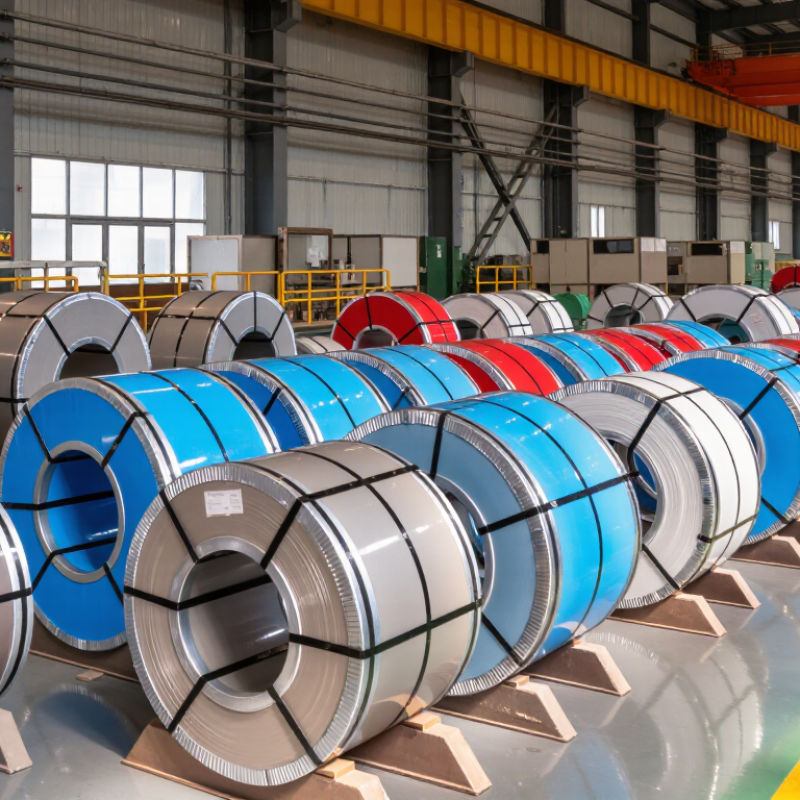
Color-coated steel coil is flat steel coated with metallic protection and a painted finish before fabrication. Common thicknesses range from 0.20 to 1.20 mm. This thickness normally describes the steel substrate, not the complete painted product. Confirm the measurement method before comparing quotations.
Tip 1 Match thickness with the application. Thin 0.20–0.40 mm coil suits light panels and indoor cladding. Thicker 0.50–1.20 mm material offers better stiffness for roofing, doors, and formed components.
Tip 2 Request the actual thickness tolerance. EN 10346 provides requirements for continuously hot-dip coated steel products, but supply tolerances still affect cutting and bending. A micrometer check at several coil points is practical. One reading is not enough.
1,888.2 million tonnes
The World Steel Association reported 1,888.2 million tonnes of global crude steel production in 2023.
This scale supports broad availability, but it does not guarantee consistent painted-coil quality.
Tip 3 Check coating mass, paint system, gloss, and color difference separately.
Tip 4 Ask for test data covering adhesion, hardness, and corrosion resistance.
ASTM A755 also highlights the importance of substrate and coating selection for prepainted steel.
Storage matters too.
Keep coils dry, ventilated, and away from standing water.
I have seen attractive surfaces fail after poor warehouse handling. A perfect specification cannot repair trapped moisture.
Consider forming radius, yield strength, width tolerance, and delivery inspection before signing the purchase order.
10 Tips for Buying Color Coated Steel Coil?
ASTM A755/A755M should guide the purchase, not replace engineering judgment. The standard covers prepainted, metallic-coated steel sheet for exterior building products. It does not select the correct steel grade for every project. Confirm the substrate standard, such as ASTM A653/A653M or ASTM A792/A792M, before comparing quotations.
Check yield strength, tensile strength, thickness, coating mass, and paint-film performance. A higher-strength grade may reduce panel thickness, but it can increase forming risk. Ask for the mill test certificate and verify measured values against the purchase specification. Small deviations matter. A 0.05 mm thickness difference can affect nesting, weight, and structural calculations. ASTM A755/A755M also requires attention to surface quality and coating application, so inspect samples under daylight, not only warehouse lighting.
The World Steel Association reported about 1.89 billion tonnes of crude steel production in 2023, showing the scale of a highly standardized market. Yet large volume does not guarantee consistent coil quality. Review coil width tolerance, camber, weld locations, packaging, and storage conditions. Confirm the intended exposure, forming radius, and corrosion environment with the supplier’s technical team. A coating that performs well inland may be unsuitable near saltwater. I have seen buyers focus too heavily on color and price. That is a costly shortcut. Match strength first, then coating and appearance. Also, allow for inspection failure; real coils are not perfectly uniform.
Buying color-coated steel coil starts with the coating system, not the surface color. Z275 zinc coating contains a minimum total mass of 275 g/m² on both sides, according to EN 10346. AZ150 aluminum-zinc coating provides 150 g/m². These values describe coating mass, not exact thickness. Check the mill certificate, coating uniformity, and test method before comparing prices.
Z275 is a practical choice for general construction, framing, and moderate outdoor exposure. Its zinc layer offers sacrificial protection when small scratches appear. AZ150 usually performs better in heat and atmospheric exposure because aluminum creates a more stable barrier. Technical guidance from the International Zinc Association reports that corrosion rates vary widely by environment, from rural air to industrial or marine conditions. Location changes the decision. Salt air is unforgiving.
Paint thickness also needs attention. A 5–10 μm topcoat may suit sheltered interiors, while 20–30 μm systems provide stronger weathering resistance. ISO 12944-5 links coating durability to environment, preparation, and paint system design, not thickness alone. Ask for primer type, topcoat resin, gloss retention data, and bending-test results. A thicker paint is not automatically better. I have seen attractive samples fail at cut edges because preparation was overlooked. Leave room for doubt, and inspect the exposed edge, not only the painted face.
When buying color coated steel coil, start with dimensional control. The World Steel Association’s Steel Statistical Yearbook 2024 reports 1.892 billion tonnes of crude steel production in 2023. Large-scale supply does not guarantee consistent coil dimensions. Request the applicable tolerance standard, such as EN 10143 or ASTM A924. Check actual width at several positions, not only at the coil head. A narrow edge can disrupt roll forming.
Thickness deserves careful attention. Measure the substrate, coating, and total thickness separately when possible. A 0.05 mm error on a 1,000-metre coil, one metre wide, changes theoretical mass by about 393 kilograms, using steel density of 7,850 kg/m³. That is not a small commercial difference. Compare the mill certificate with independent measurements. Do not trust nominal values alone. Also confirm whether the quoted weight is theoretical, gross, or net.
Surface quality needs controlled lighting. Inspect for pinholes, scratches, edge waves, oil stains, color variation, and exposed steel. EN 10169 and ASTM A755 provide useful requirements for organic-coated flat steel, but acceptance levels still need written agreement. Request coating mass, paint system, gloss, color difference, and reverse-side details. Photograph defects beside a ruler. A practical mistake is checking only the outer wraps; damage often appears deeper inside. Coil weight should be verified using a calibrated scale and matched against the packing list, core size, and coil identification. Some records are imperfect, so rechecking matters.
Check coil width, thickness tolerances, surface quality, coating weight, and total coil weight before accepting delivery. The chart shows the percentage deviation between nominal purchase specifications and sample inspection readings.
When buying color coated steel coil, treat ISO 12944 corrosion classes as a starting point, not a marketing label. ISO 12944:2018 ranks environments from C1 to C5, with CX covering extreme exposure. Its durability categories are low, medium, high, and very high. High durability generally indicates 15–25 years before the first major maintenance cycle, not guaranteed coating life.
Ask suppliers to match the coil’s actual location with the correct class. A coastal warehouse, chemical plant, and dry interior require different protection. The NACE IMPACT study estimated global corrosion costs at about US$2.5 trillion annually, equal to roughly 3.4% of global GDP. Small specification errors can become expensive repairs. Salt spray figures alone can mislead.
Review the QA file carefully. It should show substrate grade, coating mass, paint system, dry-film thickness, adhesion results, curing conditions, gloss, color variation, and batch traceability. Request test dates and equipment calibration records. ISO 12944 supports corrosion-system selection, but it does not replace product-specific testing for prepainted coil. Check relevant coil-coating standards too.
A clean certificate is not enough. I would inspect sample edges, bends, and cut surfaces before approving a large order. Look for blistering, pinholes, uneven gloss, or exposed metal. Ask whether accelerated tests represent the intended climate. They rarely reproduce every field condition. Records may appear complete, yet missing outdoor exposure data deserves careful questioning.
| No. | Buying Tip | Key Data Dimension | Recommended Requirement or Reference Value | QA Record to Request | Why It Matters |
|---|---|---|---|---|---|
| 1 | Define the exposure environment before selecting the coil | ISO 12944 corrosivity category | C1–C2 Low exposure, such as dry indoor areas C3 Moderate exposure, such as urban or light industrial areas C4 High exposure, such as industrial or coastal areas with moderate salinity C5 Very high exposure, including aggressive industrial or marine environments | Project environmental assessment, site classification, and coating recommendation | ISO 12944 corrosion classes help match the coating system to humidity, pollution, and salt exposure rather than relying only on color or appearance. |
| 2 | Check the substrate steel grade and mechanical properties | Yield strength, tensile strength, elongation, and steel designation | Confirm the specified grade for the forming process. Typical structural grades may have yield strengths around 220–350 MPa, while higher-strength grades can exceed 350 MPa. Values must follow the agreed product standard. | Mill test certificate, heat number, tensile test report, and applicable standard declaration | The correct substrate reduces cracking, edge splitting, and deformation during roll forming, bending, or fabrication. |
| 3 | Verify base-metal thickness and dimensional tolerances | Nominal thickness, width, coil weight, and flatness | Specify base-metal thickness separately from coating thickness. Confirm width and thickness tolerances against the purchase standard, with measuring equipment calibrated for the required accuracy. | Dimensional inspection report, calibration certificates, and coil identification record | Separating steel thickness from coating thickness prevents under-ordering and helps maintain structural capacity and fit-up accuracy. |
| 4 | Select the metallic coating mass for the intended service life | Zinc or zinc-aluminium coating mass | Common coating designations include approximately 60, 100, 150, 180, 275, or 350 g/m² total coating mass, depending on the product standard and corrosion requirement. Use higher coating mass for more demanding exposure when compatible with forming needs. | Coating mass test report, laboratory method, sampling plan, and test location records | Metallic coating provides sacrificial protection to the steel substrate. A higher coating mass generally offers greater reserve against corrosion, but it does not replace a suitable paint system. |
| 5 | Review the organic coating system, not just the nominal color | Primer, topcoat, back coat, resin type, and total dry-film thickness | Confirm the coating technology, such as polyester, silicone-modified polyester, polyurethane, or polyvinylidene fluoride-based systems. Typical total front-side dry-film thickness may be about 20–35 μm, subject to the approved specification. | Paint technical data sheet, dry-film thickness report, batch record, and coating-system declaration | Resin chemistry and film thickness influence UV resistance, flexibility, chalking, gloss retention, and corrosion protection at cut edges and scratches. |
| 6 | Match the coating specification to the ISO 12944 durability objective | Expected durability range | ISO 12944 durability categories are commonly expressed as: L up to 7 years M 7–15 years H 15–25 years VH more than 25 years These are planning categories, not guaranteed service lives. | Durability classification, coating-system test evidence, maintenance assumptions, and project warranty terms | Durability depends on the complete system, environment, design details, surface preparation, installation, and maintenance—not on coating thickness alone. |
| 7 | Require adhesion, flexibility, and forming performance evidence | Cross-cut adhesion, bend performance, impact resistance, and forming class | Require test results to meet the agreed product standard after bending or forming. The test method and acceptance criteria should be stated clearly, especially for tight-radius profiles. | Adhesion test record, T-bend or bend test report, impact test result, and production inspection sheet | A visually attractive coil may still fail during fabrication if the paint cracks, delaminates, or loses adhesion at bends. |
| 8 | Evaluate corrosion test data with realistic expectations | Salt spray, humidity, and cyclic corrosion testing | Use accelerated test results for comparison only. Review test duration, specimen preparation, scribe method, blistering, rust creep, and the exact acceptance criteria rather than treating a single test-hour value as a service-life guarantee. | Full laboratory report, test standard, photographs, specimen details, and results for the actual coating system | Accelerated corrosion tests can reveal weaknesses, but they do not reproduce every outdoor condition or directly convert into a fixed number of service years. |
| 9 | Inspect surface appearance and color consistency across coils | Gloss, color difference, coating defects, and surface cleanliness | Agree on color reference, viewing conditions, gloss level, allowable color difference, and defect limits before production. Inspect for pinholes, scratches, roll marks, oil stains, bare spots, and edge damage. | Color measurement report, gloss report, visual inspection record, approved reference sample, and nonconformance report if applicable | Consistent appearance supports architectural quality and helps identify coating-process variation before installation. |
| 10 | Audit traceability, packaging, storage, and delivery controls | Coil identity, packaging condition, storage limits, and shipment records | Each coil should be traceable to its heat, coating batch, inspection results, and production date. Protect coils from water ingress, condensation, mechanical impact, and prolonged outdoor storage. | Coil labels, packing list, certificate of conformity, production traceability record, loading photographs, and delivery inspection report | Good documentation makes claims verifiable and prevents wet-storage stain, edge corrosion, and handling damage from being mistaken for manufacturing defects. |
Phone: (256) 845-1255 or (256) 845-4493
Fax: (256) 845-1321 or (256) 845-4468
© 2025 Heritage Wire Harness, LLC