
Choosing a reliable Aluminum Fin Press Machine supplier affects production speed, fin accuracy, maintenance costs, and customer confidence. A strong machine should form fins cleanly, maintain stable pressure, and support consistent output across long production runs. Small details matter. Die alignment, feeder response, frame rigidity, and control-panel visibility can influence every batch.
This guide examines leading Aluminum Fin Press Machine suppliers worldwide through practical purchasing criteria. These criteria include manufacturing experience, machine specifications, quality-control procedures, after-sales support, spare-parts availability, and verified customer feedback. Buyers should also review sample results, production videos, factory capabilities, and technical documentation. A supplier’s reputation deserves evidence, not attractive claims. Clear tolerances and test records reveal more than polished brochures.
No ranking is perfect. A supplier may excel in high-volume production but offer limited customization. Another may provide responsive engineers but lack local service coverage. That difference can become expensive when a press stops during a demanding order. Careful buyers should compare cycle speed, material thickness range, tooling options, energy use, installation support, and operator training. Ask direct questions. Request realistic delivery schedules. Inspect communication quality before placing a deposit. The best choice is not always the cheapest machine. It is the supplier that consistently matches technical needs, budget limits, and long-term production plans. Some details remain uncertain until installation. That is worth remembering.
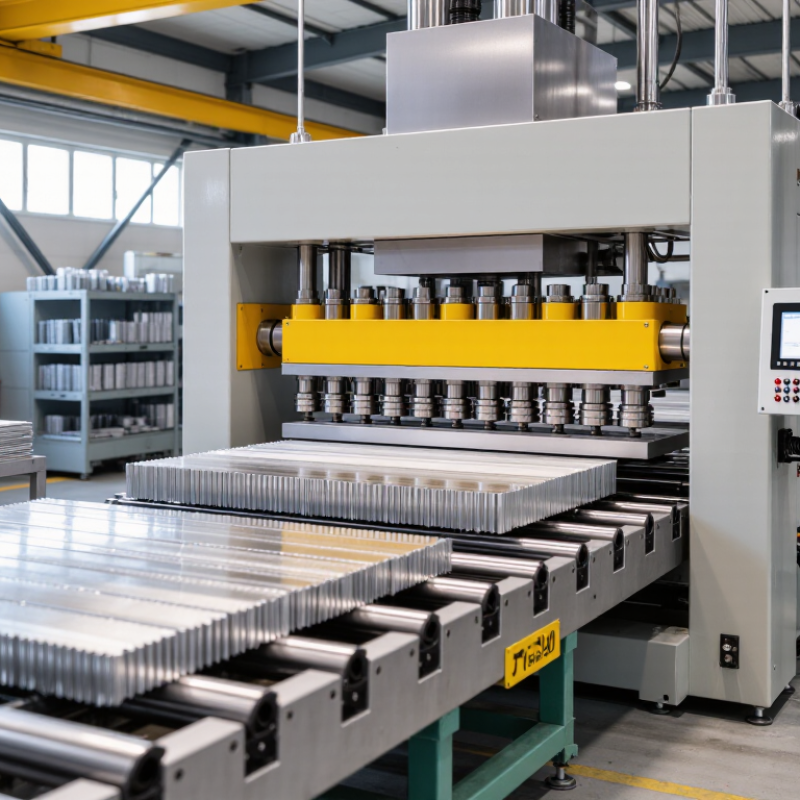
An aluminum fin press machine forms thin metal strips into precise cooling fins. It uses a punch, die, feeder, and controlled press force. The feeder moves aluminum coil material through the tooling. Each stroke creates a fin shape, notch, louver, or folded edge. These parts support heat transfer in radiators, heat exchangers, air conditioners, and other thermal systems.
The machine must match the aluminum alloy, strip thickness, fin height, and production speed. Tool clearance matters because excessive pressure can cause cracks or uneven edges. Poor feeding may create pitch errors that affect later assembly. It is not magic. Regular checks are essential.
In practical production, operators inspect the first pieces with calipers and height gauges. They also watch for burrs, wrinkles, oil buildup, and abnormal press noise. A stable machine should offer adjustable stroke settings, reliable coil alignment, guarded tooling, and accessible maintenance points. Energy use and spare-part availability also deserve attention when comparing suppliers worldwide.
Choosing equipment only by maximum press force can be misleading. Actual performance depends on tooling quality, material control, and operator training. Even experienced teams may need several trials before reaching the desired fin shape. That limitation is easy to overlook. A careful supplier should provide technical drawings, sample testing, setup guidance, and clear service documentation.
Top Aluminum Fin Press Machine Suppliers Worldwide
Key Features and Types of Aluminum Fin Press Machines
Aluminum fin press machines shape thin metal strips into fins for heat exchangers, condensers, and cooling assemblies. Their performance depends on accurate feeding, stable pressing, and controlled material handling.
Mechanical fin presses suit high-volume production and deliver rapid, repeatable strokes. Hydraulic models provide stronger force control for thicker aluminum or difficult forming profiles. Servo presses offer adjustable speed, quieter operation, and precise stroke positioning. Each type has trade-offs. A faster machine may increase output but demand stricter die maintenance.
Important features include automatic strip feeding, adjustable pitch, quick die changes, and overload protection. A reliable feeder should hold the strip firmly without leaving visible marks. Operators also need clear controls, emergency stops, and sensors for material breaks. These details reduce scrap beside the production line.
Press capacity must match the fin height, thickness, and forming pattern. Excessive tonnage can damage tooling and waste energy. Insufficient force creates incomplete louvers or uneven edges. In practical testing, measure fin pitch with gauges and inspect several pieces from each batch. I have found that the first samples often look acceptable, yet small burrs appear after longer runs. That weakness deserves attention.
Supplier evaluation should include trial production, spare-part availability, training, and documented maintenance intervals. Ask for measured tolerances, not only attractive specifications. No machine is perfect. A careful comparison usually reveals which compromises your workshop can actually manage.
The chart compares common aluminum fin press machine types using representative industry ranges for strip width and production speed. Progressive and high-speed presses are designed for higher output, while precision and louver-fin presses prioritize forming accuracy, fin geometry, and tooling flexibility. Actual specifications vary according to aluminum alloy, material thickness, fin pitch, tooling design, and automation level.
When evaluating global aluminum fin press machine suppliers, begin with verified production evidence. The International Aluminium Institute reported about 70.6 million tonnes of primary aluminum production in 2023. This scale increases pressure on manufacturers to improve throughput, material utilization, and energy control. Ask suppliers for measured cycle times, not promotional estimates. Check stroke length, press force, fin height range, strip thickness, feed accuracy, and changeover time.
Request a witnessed trial using your actual aluminum coil. Inspect fin spacing under magnification, burr formation, oil marks, and finished stack alignment. A reliable supplier should provide dimensional records and repeatability results from several batches. ISO 9001 certification supports process control, but it does not replace machine testing. Look for documented electrical safety checks, guarding, emergency stops, and technical files suited to your market.
The International Energy Agency identifies aluminum as a highly energy-intensive industrial material. Therefore, compare motor power, idle consumption, lubrication needs, and scrap rates. A lower purchase price may hide expensive tooling or weak after-sales support. Ask for spare-part lead times, remote diagnostics, installation training, and service response in writing. Supplier references should include similar fin geometries and production volumes. No scorecard is perfect. I would still reserve part of the decision for operator feedback, because catalog data rarely shows vibration, noise, or awkward maintenance access.
Aluminum fin press machine suppliers are concentrated in regions with strong metalworking traditions and mature export networks. East Asia often delivers high-speed presses, progressive tooling, and efficient automation for large-volume radiator production. Manufacturers there commonly support servo feeders, precision dies, and rapid line adjustments. However, lower pricing should not replace technical verification. Ask for measured tolerance data, trial samples, and documented factory testing.
European suppliers usually emphasize engineering depth, energy efficiency, and long service life. Their machines may include advanced controls, robust frames, and carefully designed safety systems. North American manufacturers often focus on customized production cells, maintenance access, and integration with existing plants. South Asian suppliers can provide practical configurations and competitive fabrication, especially for standard fin sizes. Quality varies between workshops. That deserves attention.
Tips: Compare press tonnage, stroke speed, fin height, material thickness, and coil width. Request a sample run using your actual aluminum strip. Check whether technicians can support die repair and software training. Inspect weld quality and alignment personally when possible. Do not trust photographs alone. A polished catalog can hide weak after-sales support. Supplier regions matter, but process evidence matters more.
| Supplier Region | Regional Market Position | Core Manufacturing Strengths | Typical Machine Configurations | Automation Capability | Customization Potential | Export and Service Advantages |
|---|---|---|---|---|---|---|
| East Asia China, Japan, South Korea and Taiwan | One of the largest global production bases for metal-forming equipment and heat-exchanger manufacturing machinery. | High-volume production, progressive die technology, precision stamping, aluminum strip handling and integrated fin-line engineering. | High-speed fin presses, multi-station progressive presses, automatic decoilers, straighteners, feeders and collection systems. | Very High Servo feeding, PLC control, automatic lubrication, vision inspection and production monitoring are widely available. | High Machine layouts can commonly be adapted for fin height, pitch, strip width, tooling and line integration. | Broad supplier capacity, established export channels and strong availability of replacement tooling and components. |
| Central Europe Germany, Italy, Switzerland, Austria and neighboring manufacturing markets | Recognized for engineering-led machinery, precision forming systems and equipment for demanding industrial applications. | Mechanical accuracy, robust frames, long service life, process stability and compliance-oriented machine design. | Heavy-duty mechanical presses, servo presses, precision feeders, modular fin-forming lines and custom production cells. | Very High Advanced controls, condition monitoring, safety systems and integration with factory automation are common strengths. | Very High Strong capability for specialized tooling, low-tolerance parts, unusual fin geometries and engineered production lines. | Strong technical documentation, established industrial service networks and broad access to European engineering resources. |
| North America United States, Canada and Mexico | Important market for automotive thermal management, HVAC, aerospace and industrial heat-transfer equipment. | Application engineering, retrofit work, high-strength production systems, controls integration and customer-specific automation. | Mechanical and servo presses, high-speed stamping systems, automatic feeding equipment and integrated inspection stations. | High Strong emphasis on robotics, data collection, safety interlocks, traceability and integration with existing plants. | Very High Well suited to engineered-to-order systems, line upgrades, replacement tooling and integration with legacy equipment. | Proximity to major industrial users, regional field service and comparatively convenient support for North American production sites. |
| South Asia India and neighboring manufacturing markets | Growing supplier base supported by expanding automotive, HVAC, power and general engineering sectors. | Cost-effective fabrication, practical mechanical design, local machining and flexible production for standard and mid-range equipment. | Mechanical fin presses, automatic strip feeders, compact fin lines and semi-automatic production equipment. | Medium to High Automation levels range from operator-assisted systems to PLC-controlled lines, depending on project scope. | High Suppliers often provide economical adaptations for local production requirements, tooling and available floor space. | Competitive project costs, expanding domestic engineering capacity and improving regional export capability. |
| Southeast Asia Thailand, Vietnam, Malaysia, Indonesia and the Philippines | Increasingly important manufacturing region for automotive components, electronics, HVAC and contract production. | Assembly, component manufacturing, regional supply-chain integration and production support for multinational factories. | Compact automatic presses, modular fin-forming lines, feeder systems and equipment configured for medium-volume production. | Medium to High Factory automation is developing rapidly, with growing demand for PLC control, sensors and production data connectivity. | High Good potential for adapting line size, feeding systems, tooling packages and plant-layout requirements. | Strategic location near major Asian manufacturing hubs and favorable access to regional component and logistics networks. |
| Western Europe France, Spain, the United Kingdom, Belgium and the Netherlands | Established industrial market with strong demand for energy efficiency, emissions reduction and advanced production control. | Process engineering, energy-conscious equipment design, quality systems, specialized tooling and regulated-industry applications. | Servo-driven presses, precision fin-forming cells, automated inspection equipment and integrated heat-exchanger production lines. | Very High Strong focus on connected manufacturing, safety compliance, predictive maintenance and energy monitoring. | High Suitable for special alloys, complex fin profiles, high repeatability and integration with existing European production systems. | Efficient access to the European industrial market, mature technical standards and strong logistics infrastructure. |
| Eastern Europe Poland, Czech Republic, Hungary, Romania and nearby markets | Competitive manufacturing region connected to European automotive, appliance and industrial supply chains. | Mechanical engineering, contract manufacturing, tooling, machine assembly and cost-efficient production for European customers. | Mechanical presses, servo-assisted feeders, modular stamping cells and medium-to-high-volume fin production systems. | High Modern installations commonly include PLC systems, automated feeding, safety controls and quality monitoring. | High Good balance between engineered customization, production flexibility and overall equipment cost. | Shorter delivery routes to European customers, access to skilled industrial labor and compatibility with European requirements. |
| Turkey and the Middle East Turkey, the Gulf region and surrounding markets | Regional source for metalworking equipment serving HVAC, construction, appliance and industrial fabrication sectors. | Sheet-metal processing, practical machine fabrication, HVAC-related equipment and regional project support. | Standard and customized mechanical fin presses, strip-processing equipment and compact production lines. | Medium PLC control and automatic feeding are available, while advanced inspection depends on project requirements. | High Suppliers can often adapt equipment to regional HVAC products, available utilities and production volumes. | Convenient access to Europe, Central Asia and Middle Eastern markets, with competitive fabrication and installation support. |
Choosing a top aluminum fin press machine supplier requires more than comparing purchase prices. International Aluminium Institute data shows recycled aluminum uses about 5% of the energy required for primary aluminum. This makes material efficiency important during fin forming. Ask suppliers for measured scrap rates, stroke stability, tooling life, and energy consumption per production cycle. Factory acceptance tests should include fin height, pitch, burr control, and repeatability across several batches. A glossy sample is not enough.
Tips: Request three months of service records from similar installations. Confirm spare-part availability, response times, training, and remote diagnostics in writing. Also inspect the supplier’s quality system, calibration records, and operator training process. ISO 9001 certification can support reliability, but it does not guarantee machine performance. Independent testing remains useful. Very useful.
After-sales support often determines the real cost of ownership. The International Energy Agency continues to emphasize industrial efficiency and electrification as important emissions-reduction measures. A press with lower energy demand may reduce operating costs, but only if it maintains output quality. Ask for a total-cost model covering dies, lubrication, maintenance labor, downtime, and software updates. In my experience, buyers sometimes overvalue maximum speed. That can be a mistake when thin fins wrinkle or tooling wears quickly. Suppliers should provide failure-analysis procedures and measurable warranty terms, not vague promises. Leave room for review; production conditions rarely match the showroom.
Phone: (256) 845-1255 or (256) 845-4493
Fax: (256) 845-1321 or (256) 845-4468
© 2025 Heritage Wire Harness, LLC