7 Best Wire Harness Production Companies for Global Buyers
Choosing among the 7 best wire harness production companies takes more than comparing prices or polished factory photos. Buyers need to know how each supplier handles drawings, material choices, testing, and changing order volumes. A connector can look right on a screen and still fit poorly after assembly. Small details matter.
Automotive engineering pioneer Charles Kettering is often credited with the line, “A problem well stated is a problem half solved.” It applies here: clear specifications make supplier discussions more useful. Before requesting quotes, define cable lengths, connector types, labeling, expected volumes, and inspection needs. Then ask how the manufacturer verifies continuity, protects terminals, and controls revisions. These checks help buyers compare capabilities, not just claims.
This guide reviews seven companies serving global buyers and highlights practical points to consider when assessing their wire harness production services. The comparison focuses on manufacturing scope, quality practices, customization, and communication across borders. Company strengths can vary by project, and published information may not reveal every limitation. No supplier is perfect. Ask for relevant samples, process details, and a clear plan for handling defects before committing. A little skepticism is useful; it can also slow a decision. That trade-off deserves attention.
Wire Harness Production: Core Processes and IPC/WHMA-A-620 Standards
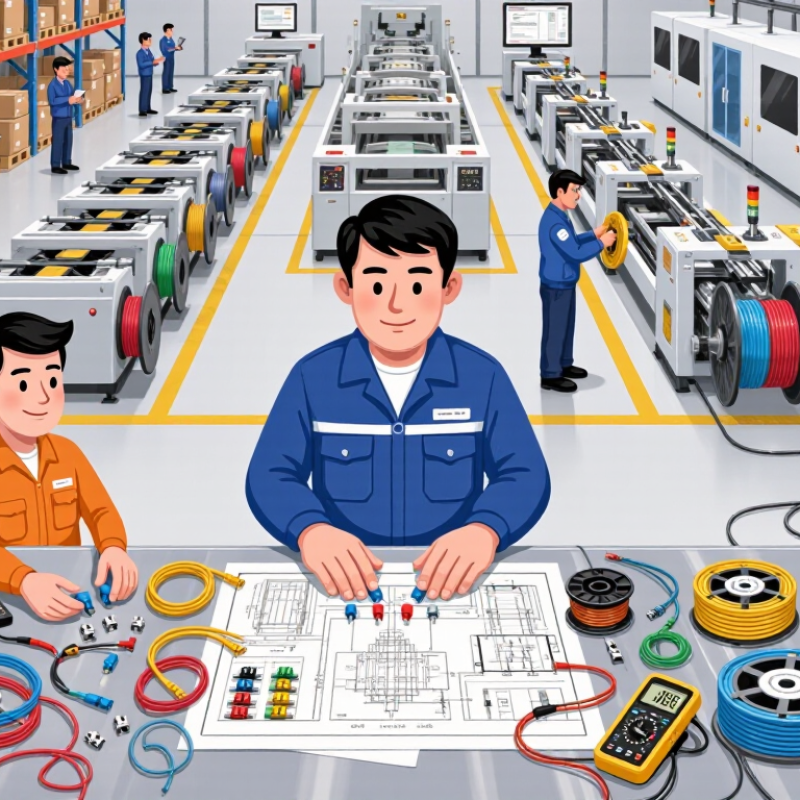
Wire harness production turns a wiring diagram into a tested assembly. Typical steps include wire cutting, insulation stripping, terminal crimping, connector loading, routing, labeling, and electrical testing. A poorly adjusted crimp tool can leave a terminal that looks secure but pulls free under load. Small details matter.
OICA’s 2023 Production Statistics report records 93.5 million motor vehicles produced worldwide. That scale makes repeatable work instructions and traceable inspections important, especially when harnesses vary in length, branch points, and connector count. IPC/WHMA-A-620 defines workmanship and acceptance criteria for cable and wire harness assemblies. It addresses areas such as crimping, soldering, splices, and mechanical assembly. Its three product classes reflect different end-use requirements; buyers should specify the applicable class rather than assume one level fits every assembly.
A practical review checks stripped-wire length, crimp height, conductor placement, insulation support, connector locking, and continuity. Inspectors may use visual checks, pull tests, and electrical tests according to the product requirements. The standard supports consistent acceptance, but it does not replace clear drawings or process control. A checklist can still miss a flawed drawing. That deserves attention. Sources: OICA, 2023 Production Statistics; IPC/WHMA-A-620, Requirements and Acceptance for Cable and Wire Harness Assemblies.
Wire Harness Production: Core Processes and IPC/WHMA-A-620
A typical production sequence, from engineering release through final inspection. The numbered bars indicate order only—not time, cost, or quality scores.
IPC/WHMA-A-620 sets workmanship acceptance criteria for cable and wire harness assemblies. It does not define a universal numeric score for these process steps; applicable requirements depend on the product and agreed class.
IPC/WHMA-A-620’s 3 Product Classes: Class 1, 2, and 3
For global buyers, IPC/WHMA-A-620’s three product classes help translate end-use risk into wire harness workmanship and inspection criteria. Class 1 covers general electronic products where the main requirement is function. Class 2 serves dedicated, longer-life applications with more demanding performance expectations. Class 3 applies to high-performance products where continued operation is critical and downtime is costly. The class should follow the equipment’s use, not simply a supplier’s preference.
The distinction matters at the workbench. A Class 1 harness may allow acceptance conditions that would fail Class 3 inspection. For Class 3, inspectors pay closer attention to details such as conductor damage, crimp shape, insulation clearance, and connector locking. Small details count. IPC/WHMA-A-620 defines acceptance criteria; it does not promise that a product will never fail. Buyers should specify the applicable revision, class, test plan, and any customer-specific requirements in purchasing documents.
Demand adds pressure to choose carefully. Grand View Research’s 2023 Automotive Wiring Harness Market report estimated the market at USD 50.87 billion in 2022 and projected 4.8% annual growth through 2030. That figure is automotive-specific, not a measure of every harness sector. Still, it shows why production scale and repeatable inspection matter. One uncomfortable point: a higher class can increase inspection and process costs without improving a low-risk application. A clear risk review helps prevent both under-specification and needless expense.
Supplier Certifications: ISO 9001, IATF 16949, and ISO 13485
For global buyers comparing wire harness production companies, certifications offer a useful starting point. ISO 9001 indicates a documented quality management system, including controls for inspection, corrective action, and supplier evaluation. Ask for the current certificate and confirm that its site and scope cover the factory producing your harnesses. A certificate displayed in a presentation may not cover every facility.
IATF 16949 is especially relevant to automotive supply chains. It emphasizes process consistency, risk management, traceability, and actions that prevent recurring defects. During an audit, ask how the supplier tracks a wire lot from incoming inspection through crimping and final testing. A clear answer should include records, not just assurances. Small details matter.
ISO 13485 applies to quality systems for medical-device production. It may be important when harnesses support medical equipment, but it does not automatically approve a finished device or prove every product meets your requirements. Check whether the certified scope matches the work, and review controls for change management, component identification, and documented inspection. Paperwork can look reassuring. It is still worth checking how procedures work on the production floor, where rushed handoffs can expose gaps.
7 Wire Harness Production Companies for Global Buyers
Choosing among seven wire harness production companies for global projects requires more than comparing unit prices. Buyers should examine production capacity, engineering support, and documented quality controls. Ask how each supplier verifies crimp height, pull force, continuity, and insulation resistance. Request sample inspection records and traceability details for individual production lots. These checks reveal whether a neat prototype can be reproduced across large orders. It sounds simple. It isn’t.
The International Energy Agency’s Global EV Outlook 2024 reported nearly 14 million electric car sales worldwide in 2023, about 18% of total car sales. It also projected more than 17 million sales in 2024, exceeding one in five new cars. This shift raises demand for harnesses that handle high-voltage circuits, varied connector requirements, and changing vehicle designs. Global buyers should confirm a manufacturer’s experience with relevant cable types and its process for managing engineering changes. Compare lead times, material sourcing plans, and communication across time zones. A lower quote can still carry hidden costs if drawings, testing criteria, or delivery schedules remain unclear. Ask for specifics before committing.
How to Compare Suppliers Across 5 Key Sourcing Criteria
A useful comparison of wire harness production companies starts with five sourcing criteria: engineering capability, quality control, capacity, supply continuity, and communication. Check whether the supplier can interpret drawings, recommend suitable terminals, and document changes clearly. Ask for evidence. Sample harnesses should match the specified wire gauge, connector layout, and labeling—not just look tidy in a photo. Details matter.
Review quality records for inspection steps, defect handling, and lot traceability. Ask how operators verify crimp height and pull strength, and whether test results can be tied to a production batch. Then compare realistic capacity and lead times, including peak-season constraints. A confident delivery estimate is not proof of available line time. Not every sample scales.
For global sourcing, map key materials to their actual sources and ask what happens when a component is delayed. Compare communication practices too: response speed, change approval, and clarity around shipping documents can affect daily operations. Finally, assess total cost rather than unit price alone. Include tooling, testing, packaging, freight, and the cost of revisions. Keep the review practical. A small pilot order can reveal process gaps, though it cannot guarantee every future batch will be identical.